

Disclosure: Classy Floor is reader-supported. As an Amazon Associate, we earn from qualifying purchases. We may also earn commissions from other affiliate programs, at no additional cost to you. Learn more →
How long does carpet installation take? A professional crew can usually finish one standard room in 2 to 4 hours, several rooms in about 4 to 8 hours, and a typical whole-house carpet installation in roughly 1 to 2 days. Installing carpet on a straightforward flight of stairs often adds another 3 to 6 hours.
Those are planning ranges, not fixed promises.
Furniture, old carpet removal, subfloor repairs, room shape, seams, stairs, pattern matching, and crew size can all change the schedule.
Here is the part many homeowners do not expect: square footage alone is a poor predictor of installation time. A large empty rectangle may be easier to carpet than a much smaller staircase with a landing, railing posts, and dozens of detailed cuts.
Carpet Installation Time at a Glance
For a typical professional installation, these ranges give you a realistic starting point.
| Project | Typical Installation Time | What Usually Adds Time |
| Small bedroom | 2 to 3 hours | Furniture, closet cuts, old flooring |
| Average bedroom | 2 to 4 hours | Seams, transitions, subfloor prep |
| Living room | 3 to 6 hours | Large seams, irregular layout, furniture |
| Two to three rooms | 4 to 8 hours | Doorways, transitions, repeated setup |
| One straight flight of stairs | 3 to 6 hours | Treads, risers, railing details |
| Stairs plus landing | 4 to 8 hours | Turns, exposed edges, detailed fitting |
| Typical whole house | 1 to 2 days | Multiple rooms, stairs, preparation |
| Complex whole-house job | 2 days or more | Repairs, patterns, difficult access |
A prepared room usually lands near the shorter end. Once installers uncover subfloor damage, difficult seams, or furniture that still needs to move, the estimate can change quickly.
Carpet cushion also affects how smoothly the job goes around doorways, perimeter edges, and stairs. Choosing padding that suits the carpet and the room before installation day avoids another decision while the crew is ready to work.
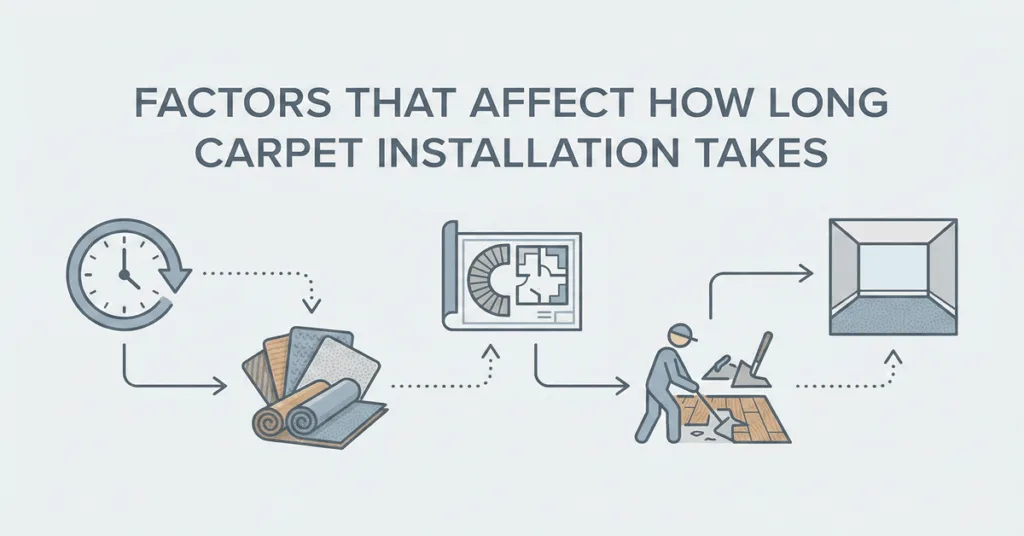
What Can Add Time to a Carpet Installation?
Use this as a planning guide rather than a stopwatch.
| Project Condition | Possible Effect on the Schedule |
| Furniture still in the room | Often adds 30 to 90 minutes or more |
| Old carpet and padding removal | May add an hour or more per room |
| Heavy staples or glued material | Can extend removal considerably |
| Minor subfloor cleanup or isolated repairs | May add less than an hour |
| Significant leveling or subfloor repair | Can add several hours or another day |
| Pattern matching or multiple seams | Adds fitting and alignment time |
| Straight staircase | Commonly adds 3 to 6 hours |
| Stairs plus landing | Often takes 4 to 8 hours total |
| Difficult access | Adds carrying and setup time |
The estimates overlap because real installations do too. One crew might remove clean carpet from a bedroom in 30 minutes, while another room hides hundreds of staples and a damaged section of subfloor.
That uncertainty is why experienced installers usually give a time window rather than promise an exact finish minute.
How Long Does It Take to Install Carpet in One Room?
For most bedrooms, professional carpet installation takes about 2 to 4 hours once the space is ready.
A small, empty bedroom with four straight walls and a clean subfloor may finish closer to two hours. A larger bedroom with a walk-in closet, several doorways, or furniture can move toward four hours or longer.
Living rooms commonly take 3 to 6 hours. They may require longer seams, wider carpet sections, transitions to hardwood or tile, floor-vent cuts, or fitting around a fireplace.
Here’s the thing: installers spend a lot of time on the parts of the floor that have almost no square footage.
Consider a 15-by-20-foot rectangular room. Now compare it with a smaller bedroom that has two closets, five door jambs, a bay window, and an angled wall. The smaller room may take longer because every interruption creates another measurement, cut, tuck, or transition.
Does Moving Furniture Add Much Time?
Yes, especially when the crew has to move large pieces more than once.
An empty room lets installers start immediately. Beds, dressers, sectionals, entertainment centers, and packed closets break that workflow.
Before installation day, ask who handles large furniture and whether moving it costs extra. Clear lamps, electronics, decorations, clothes, small tables, and other easy items yourself when possible.
That simple preparation often saves more useful time than trying to calculate installation down to a few minutes per square foot.
How Long Does It Take to Install Carpet on Stairs?
A standard straight staircase usually takes about 3 to 6 hours to carpet.
That sounds like a long time for such a small area. It makes more sense when you look at the work.
The installer handles every tread and riser individually, controls carpet tension, trims each edge, works around walls or railing posts, and finishes the material where the stairs meet a hallway or landing.
A living room gives the installer large open areas to work with. A staircase creates a sequence of small precision jobs.
That is why stair installation time can rival the time needed for a much larger room.
How Long Does It Take to Fit Carpet on Stairs and a Landing?
For one flight of stairs plus a landing, 4 to 8 hours is a sensible planning range.
A straight staircase with easy access may finish sooner. Turns, irregular landings, exposed edges, detailed nosing, spindles, and railing posts add cutting and fitting time.
The fitting style matters too. If you have not decided how the carpet should follow each tread and riser, comparing different ways carpet can be fitted around stair profiles before installation can help settle that detail before the first cut.
What Makes Stair Carpet Installation Slower?
Curved stairs, multiple landings, patterned carpet, damaged treads, old staples, exposed edges, railing posts, and difficult nosing all slow the work.
One counterintuitive detail is worth remembering. Adding another 50 square feet to an open bedroom may barely affect the schedule, while adding one awkward stair landing can.
Installation labor follows complexity, not just area.
How Long Does Carpet Fitting or Laying Carpet Take?
In the United States, homeowners usually call the job carpet installation. In the UK and some other markets, people often search for carpet fitting, fitting a carpet, or laying carpet.
They are generally describing the same on-site stage of the project.
So, how long does it take to fit a carpet?
For a standard bedroom, expect around 2 to 4 hours. Several uncomplicated rooms can take most of a working day. A typical whole-house carpet fitting project may require 1 to 2 days.
The terminology changes slightly as well. A U.S. installer may talk about carpet padding and tack strips, while a UK carpet fitter may refer to underlay and gripper rods.
The search terms differ, but the practical question remains the same: how long until the carpet is fitted and the room can go back into use?
On stairs, the timeline stays slower. Laying carpet on one straightforward flight often takes 3 to 6 hours, with additional time for a landing or complicated edge work.
What Makes Carpet Installation Take Longer?
Most delays come from preparation and detail work rather than covering the open center of a room.
Old Carpet Removal
If the crew also removes the existing carpet, allow extra time at the beginning of the job.
A simple bedroom may only add an hour or so. Heavily stapled padding, glued material, difficult disposal, or stairs can take much longer.
The bigger question is what installers find underneath.
If you plan to handle demolition yourself, removing the existing carpet correctly before the appointment can give the installation crew a cleaner starting point. Check the quote first because removal and disposal may already be included.
Subfloor Condition
Subfloor problems are among the hardest delays to predict before the old flooring comes up.
Installers may uncover loose panels, squeaks, low areas, old adhesive, damaged wood, cracked concrete, or signs that moisture needs further investigation.
The Carpet and Rug Institute includes subfloor preparation as a core part of its residential carpet installation standard, which is one reason a professional installer should address the surface below the carpet before covering it.
A few remaining staples or a small isolated repair may add little time. Leveling a floor, replacing damaged panels, or dealing with moisture can push the installation into another day.
Seams and Pattern Matching
Large rooms may require more than one piece of broadloom carpet.
Where two pieces meet, installers typically align the carpet carefully and may use seam tape to create a secure joint. They also need to keep pile direction consistent so the finished floor does not look mismatched from one section to another.
Patterned carpet requires even more care. A small alignment error can become obvious across a long seam, so the installer may spend additional time positioning and trimming before joining the pieces.
Fast work is useful. A rushed visible seam is not.
Stretching, Trimming, and Transitions
Most residential broadloom carpet uses a stretch-in installation.
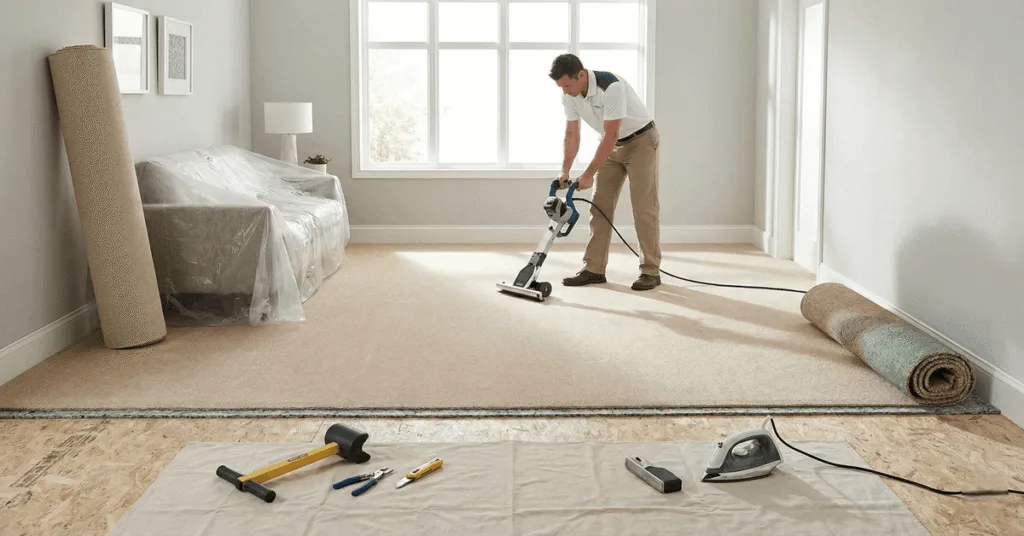
After laying the padding and positioning the carpet, installers typically use a power stretcher to create even tension across the room. They then trim and tuck the carpet along walls and finish it at doorways with the appropriate threshold or transition strip.
This part should not be rushed.
Poor tension can contribute to ripples or wrinkles later. If you want to understand why installers do more than pull carpet tight with a knee kicker, learning how proper carpet tension is created makes the extra fitting time easier to understand.
Crew Size and Access
Two installers can often move through removal, preparation, carpet positioning, seam work, and stretching faster than one person.
Access can erase part of that advantage.
A third-floor apartment with a narrow stairwell, no freight elevator, and limited parking may take longer than a larger first-floor room. Long carrying distances and building work-hour restrictions consume time without adding a single square foot of carpet.
That is another reason room-by-room estimates usually beat simple square-foot calculations.
What Happens on Carpet Installation Day?
Most residential carpet installations follow the same basic sequence.
The crew confirms the rooms and moves any furniture included in the job. If necessary, they remove the old carpet and padding.
Next comes the part homeowners rarely see once the floor is finished: the subfloor inspection.
Installers clean the surface, address necessary repairs, check or install tack strips, place the carpet padding, position and cut the carpet, complete seams, stretch the material, trim the perimeter, tuck the edges, and finish transitions.
Then they clean the work area and inspect the finished floor.
In practice, the subfloor inspection is where an easy schedule can suddenly change. Anyone who has pulled up old flooring knows that the surface underneath does not always match the one you hoped to find.
That uncertainty explains why a professional crew may hesitate to promise an exact finish time before removal starts.
Can Carpet Be Installed in One Day?
Yes. Many residential carpet projects finish in a single day.
One to three straightforward rooms can often fit comfortably within normal working hours when the house is ready. A modest whole-house installation may also finish in one long day with a larger crew and simple room layouts.
A one-day installation becomes much more realistic when:
- The carpet and padding are already available
- Furniture is cleared
- Old flooring comes up easily
- The subfloor needs no major repair
- Rooms have simple layouts
- Pattern matching is minimal
- There are no complicated staircases
Stairs, difficult seams, subfloor repair, furniture moving, and detailed fitting reduce that margin.
Think about it this way: asking whether installers can finish in one day is different from building your entire schedule around the assumption that they will.
For a whole house, 1 to 2 days remains the safer planning range.
How Long From Ordering Carpet to Installation?
The actual installation may take only a few hours, while the full carpet project takes much longer.
Before the crew arrives, you may need room measurements, carpet selection, padding selection, quote approval, product ordering, delivery, and installer scheduling.
In-stock carpet can move through that process quickly. Special-order colors, patterns, or materials may require additional lead time. Installer availability can create another delay even when the carpet is already sitting in a warehouse.
Keep two timelines separate:
Lead time is the period before installation begins.
Installation time is the time the crew spends completing the flooring work inside your home.
When requesting a quote, ask for both. That prevents a “one-day installation” estimate from sounding like the entire buying and installation process takes one day.
Does Extra Installation Time Increase the Cost?
Sometimes, because the same complications that extend the schedule often require more labor.
Current U.S. consumer pricing from HomeGuide’s carpet installation cost data places installed carpet broadly around $2 to $8 per square foot, with labor commonly around $0.50 to $1.50 per square foot. Actual prices vary by carpet, padding, location, room layout, stairs, removal, and subfloor work.
For perspective, a 12-by-12-foot bedroom has 144 square feet. Using that broad installed range, the project could land around $288 to $1,152 before unusual repairs or other project-specific charges.
That is a budgeting example, not a contractor quote.
If cost becomes a bigger part of your decision than timing, the factors that affect what you ultimately pay for professional carpet installation deserve a separate look rather than turning this timing guide into a cost guide.
How Soon Can You Walk on New Carpet?
For most stretch-in residential carpet, light foot traffic is usually possible once the installer finishes and confirms that the room is ready.
Glue-down carpet works differently. Adhesives can have product-specific cure and traffic requirements, so follow the manufacturer’s instructions and the installer’s guidance rather than assuming one universal waiting period.
Be careful when returning furniture.
Lift heavy pieces rather than dragging them across fresh carpet. This protects the pile and avoids unnecessary stress on newly finished seams and edges.
How Long Should You Ventilate After Carpet Installation?
Fresh carpet, cushion, adhesive, and other installation materials can produce noticeable odors.
The U.S. Environmental Protection Agency recommends increasing ventilation during installation and continuing additional ventilation for 48 to 72 hours afterward. Following the EPA’s guidance on ventilation around new carpet can help move indoor air through the room while the initial odor fades.
Open windows when weather allows and keep suitable ventilation running.
If an unusually strong odor continues, contact the retailer or carpet manufacturer rather than trying to cover it with fragrances.

Frequently Asked Questions
How long does it take to replace carpet in one bedroom?
A typical bedroom carpet replacement takes about 2 to 4 hours when the room is ready and the subfloor is in good condition. Furniture, old carpet removal, closets, and repairs can extend the job.
How long does it take to install carpet in a whole house?
A typical whole-house carpet installation takes about 1 to 2 days. Larger homes, stairs, pattern matching, difficult access, or subfloor repairs may require more time.
How long does it take to install carpet on stairs?
Expect roughly 3 to 6 hours for one straightforward flight of stairs. Landings, curves, railing posts, and detailed fitting can extend the schedule.
How long does it take to fit carpet on stairs and a landing?
One typical staircase plus a landing commonly takes around 4 to 8 hours, depending on the layout and the amount of detailed cutting.
How long does it take to lay carpet in one room?
Professional carpet laying in a straightforward bedroom usually takes about 2 to 4 hours once the room and subfloor are prepared.
Does removing old carpet add much time?
It can add an hour or more to a typical room. Heavy staples, glue, stairs, difficult disposal, or hidden subfloor damage can add several hours.
How Much Time Should You Set Aside?
For practical planning, how long does carpet installation take comes down to three useful numbers: about 2 to 4 hours for one standard room, 3 to 6 hours for a straightforward staircase, and roughly 1 to 2 days for a typical whole house.
Do not estimate the job from square footage alone.
Room shape, furniture, old flooring, subfloor condition, seams, pattern matching, stairs, access, and crew size can matter just as much. An empty rectangular bedroom can move quickly. A much smaller stair-and-landing project may keep an installer busy for most of the day.
Before installation day, confirm who will move the furniture, who will remove the old carpet, how unexpected subfloor repairs will be handled, and what time range the installer expects for your specific rooms.
Then plan around that range, not the best-case number.