
Disclosure: Classy Floor is reader-supported. As an Amazon Associate, we earn from qualifying purchases. We may also earn commissions from other affiliate programs, at no additional cost to you. Learn more →
The way your stair carpet wraps over each step shapes how safe and stylish your staircase feels each day. When homeowners compare waterfall vs hollywood style carpet stairs, they choose between a relaxed carpet cascade and a crisp, contoured tuck around each tread and riser.
You might worry about kids racing up the stairs, a dog sliding on the edge, or guests noticing frayed carpet. Style plays a role, yet budget, high-traffic wear, stair runners, padding, and stair nosing still decide which method fits your hallway or basement steps.
This guide walks you through look, safety, cost, and maintenance for each stair carpet style using plain language and real-life scenarios. By the end, you will know which installation suits your staircase, how to speak with an installer, and where DIY makes sense.
Waterfall vs Hollywood carpet stairs at a glance (quick comparison)
Waterfall and Hollywood carpet stairs offer two distinct ways to wrap carpet over each tread and riser, with waterfall creating a smooth drop from tread to riser and Hollywood forming a tight, tucked shape under the stair nose.
These methods change how your staircase looks, feels, wears, and handles daily traffic. Most homeowners compare them because they want the right mix of style, safety, and long-term stability. If you’re also weighing different stair-nose shapes, it helps to understand how rounded bullnose and sharper waterfall edges affect the finish on stairs.
If you’d like to see real-world stair runner options while you read, you can browse current stair runner styles and prices to get a feel for patterns, widths, and price ranges.
If you’ve ever wondered why some staircases look soft and relaxed while others show each step clearly, this section gives you the quick clarity you need. Waterfall leans casual and budget-friendly, while Hollywood leans crisp and secure for busy homes or focal-point stairs. Each method works well with stair runners, padded steps, and different carpet types, which is why a fast overview saves time before you explore the deeper details.
Comparison table: key differences side by side
| Feature | Waterfall Style | Hollywood Style |
| Look | Smooth drop with a relaxed cascade | Tucked under the nosing with a crisp, contoured profile |
| Installation | Faster and simpler for installers | Slower, more detailed, requires precision |
| Cost | Usually lower | Usually higher due to added labor |
| Durability | Good for low–medium traffic | Strong hold in high-traffic areas |
| Best Use Cases | Rentals, basements, budget updates | Main entry stairs, designer runners, homes with kids or pets |
| Carpet Compatibility | Works well with thicker plush styles | Great for patterned runners and low–medium pile carpet |
| DIY Friendliness | More approachable | Better left to pros |
When a quick answer is enough (rule-of-thumb guide)
If you prefer a simple, flowing look and want the most affordable option, waterfall fits almost any straight staircase. If you want maximum grip at the stair nose or love the defined look of a runner that hugs each tread, Hollywood is the better fit.
A fast decision checklist:
- Choose waterfall for simple projects, thick carpet, or lower traffic.
- Choose Hollywood if safety, sharp detail, or long-term hold matter most.
This high-level overview sets the foundation for the detailed breakdown of each method that follows.
If you’re leaning toward a runner, you can compare popular stair runners designed for high-traffic stairs to see which patterns and materials match your space.
How waterfall style carpet stairs work (installation, pros, and drawbacks)
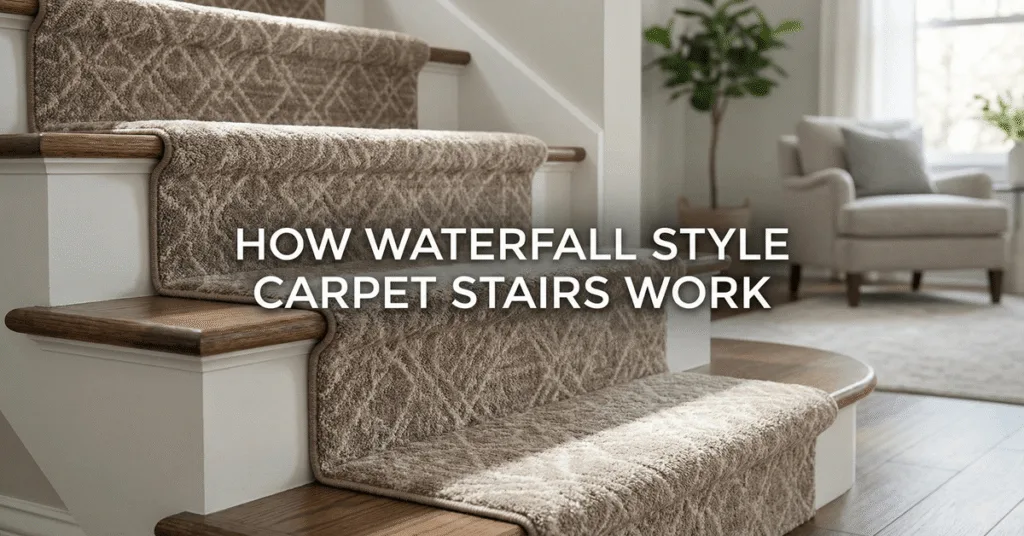
Waterfall carpet stairs create a smooth, uninterrupted line from one tread to the next, with the carpet dropping straight down the riser instead of wrapping tightly under the nose. This style is common in budget-friendly installs, rental homes, and secondary staircases because it’s fast, simple, and works with plush carpet that doesn’t bend sharply.
Homeowners like waterfall stairs because the look feels soft and relaxed, almost like the carpet “pours” over the steps. The lack of tight tucking makes it easier for installers to stretch the carpet evenly across an entire flight. If you’ve ever seen older stairs where a patterned runner still looks clean despite age, there’s a good chance it was installed waterfall style.
What is waterfall style on stairs?
Waterfall style means the carpet is stretched over the tread and allowed to fall straight to the next riser without contouring the stair nose. Installers typically use tack strips at the back of each tread and at the base of each riser, securing the carpet through tension rather than detailed shaping. The result is a clean, simple line that suits most standard staircase layouts.
This method avoids tight bends, so it handles plush and high-pile carpets well. If you use a thick pad or cushioned underlay, the waterfall style keeps everything smooth and comfortable underfoot without showing every edge.
Waterfall installation process in simple steps
The process usually follows a short, predictable sequence:
- Inspect and repair treads, squeaks, and loose boards.
- Place tack strips on the tread and at the base of each riser.
- Lay the carpet pad, trimming it a bit short of the nosing.
- Stretch the carpet across the tread with a knee kicker.
- Pull the carpet down the riser and secure it at the bottom.
- Repeat step by step, keeping tension consistent across the staircase.
- Trim cleanly at the landing or at the top step.
DIY-minded homeowners sometimes take this on, though pro installers can achieve tighter, more even results. A basic toolkit, a knee kicker, a utility knife, and a stair tool are usually enough for a small project. If you don’t already own these, you can check current prices on stair carpet tool kits or pick up a separate knee kicker and stair tool to get set up.
Pros and cons of waterfall carpet stairs
Pros:
- Lower installation cost
- Works with thicker carpets that resist tight bends
- Faster installation on straight stairs
- Great for rentals or budget renovations
Cons:
- Less secure at the nosing over time
- Carpet may loosen more quickly in high-traffic homes
- Edges may not look as sharp as Hollywood style
- Not ideal for patterned carpets requiring precise alignment
Best use cases for waterfall style
Waterfall shines in relaxed, low-maintenance spaces: basement steps, side staircases, hallways that don’t get constant foot traffic, or budget-friendly makeovers. Frieze, plush, and berber carpets often shape well with this style, especially when the goal is comfort over formality.
If you want a soft, simple finish without the precision (and cost) of a detailed tuck, waterfall gives you a clean, comfortable result.
How Hollywood style (tucked/cap-and-band) carpet stairs work
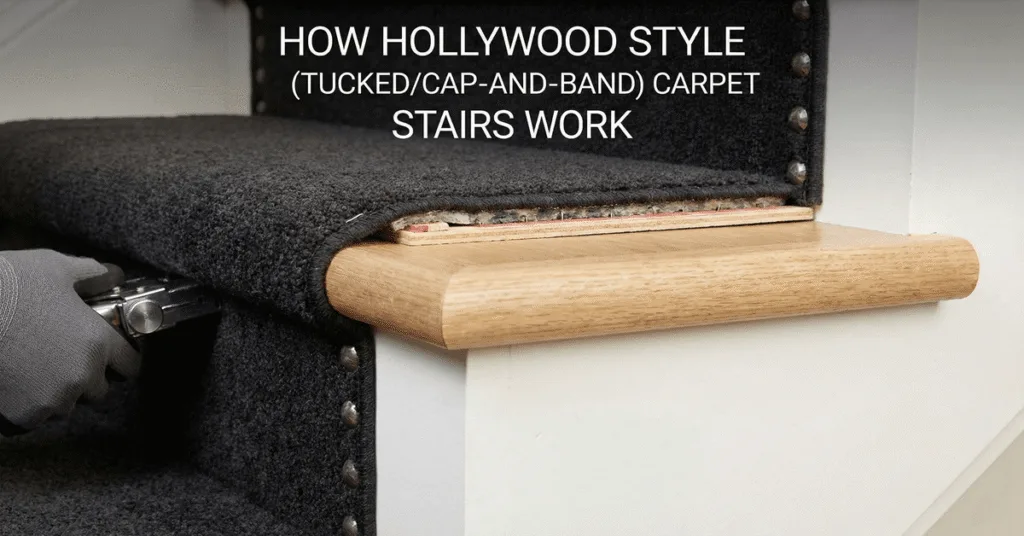
Hollywood style carpet stairs use a tight, tailored wrap that hugs each stair tread, riser, and stair nosing, giving the staircase a crisp, high-end look and a firm edge underfoot. This method, often called tucked, cap-and-band, or French cap, relies on careful fitting, extra fastening, and clean lines that turn the stair runner into a clear design feature instead of a soft cascade.
What is Hollywood style carpet on stairs?
Hollywood style carpet on stairs is a method where the carpet wraps snugly over the stair nosing, tucks under the lip, and fits closely against the riser to create a neat, contoured profile. The installer shapes the carpet to follow each step, so the runner looks structured, with each tread and riser clearly defined.
This tight wrap gives the staircase a sharp edge, which suits formal foyers, open staircases, and homes that feature patterned stair runners. Many installers group Hollywood, cap-and-band, and French cap under the same umbrella, even though small changes in cuts or stapling lines can set them apart. If you ask a local carpet fitter for a “tucked” stair runner, you are usually talking about this same family of styles.
Hollywood installation process and what makes it different
Hollywood installation stands out because the carpet is pulled firmly over the nosing, tucked underneath, and stapled or tacked in place for a close fit that resists movement. The process calls for more precision, more fastening points, and more time than a simple waterfall installation.
An installer starts by fitting pad and tack strips to each stair, then measures the stair runner so patterns line up from step to step. They use tools like a knee kicker, stair tool, and power stretcher to pull the carpet tight over the nosing, staple under the lip, and press the carpet into the angle between tread and riser. Extra care goes into corners, open-sided steps, and turns, since a small mistake can throw off pattern alignment.
This method suits dense, low- to medium-pile carpets and patterned runners, because crisp folds keep lines straight and motifs clear. Do you want stripes that match across every tread or a border that frames each step? Hollywood style makes that visual more realistic than a looser, draped approach.
Pros and cons of Hollywood carpet stairs
Hollywood carpet stairs give a staircase a tailored look, firm edge, and strong grip, which many homeowners link to better safety and a more “finished” feel in high-traffic areas. The trade-off is higher labor cost, more dependence on installer skill, and less forgiveness with very thick plush carpets.
Pros of Hollywood style
- Clean, structured look that suits formal entryways and open staircases
- Tighter fit around nosing, which can cut down on trip points and loose edges
- Better pattern control for stripes, borders, and detailed motifs
- Often holds shape longer on busy stairs when installed correctly
Cons of Hollywood style
- Higher labor cost than basic waterfall installation in many regions
- More prep time and skill needed, so choice of installer matters more
- Less relaxed feel on the stair edge, which some people find less cushioned
- Very thick or floppy carpet can look bulky or hard to shape cleanly
This style shines when you value tidy lines, visible craftsmanship, and long-term stability more than the soft sweep of a waterfall stair runner. A short chat with a flooring pro who has photos of past Hollywood jobs can make the trade-offs very clear.
When Hollywood style makes the most sense
Hollywood style makes the most sense on staircases that act as a focal point and carry regular foot traffic, such as main stairs in a family home, an open stair in a townhome, or a statement staircase in a hallway that guests see first. The tight wrap and clean edge help the stair runner stand up to daily use, especially in homes with children, older adults, or pets.
Patterned runners with borders, geometric designs, or stripes tend to perform well with this method, since each tread acts like a frame for the design. Many designers pick Hollywood style for hardwood stairs with white risers and dark treads, where the runner sits between two strips of exposed wood and needs sharp, straight edges.
If you want clear definition on each step, firm footing near the nosing, and a staircase that looks more custom than casual, Hollywood style sits near the top of the list. This sets up the next question for most homeowners: how does that choice affect cost, durability, and day-to-day care when compared with a simple waterfall installation?
Cost, durability, and maintenance: waterfall vs Hollywood
Cost, durability, and maintenance for waterfall vs Hollywood style carpet stairs depend on labor time, carpet quality, pad type, and the shape of the staircase, yet clear patterns show up across most homes and installers. Waterfall stairs usually sit at the lower end of the labor range and favor softer, thicker piles, while Hollywood stairs often cost more to fit but deliver a tighter edge and stronger long-term hold in high-traffic areas.
Installation cost ranges for each style
Waterfall installation tends to cost less per stair or per linear foot than Hollywood style, since the fitter can move faster and use simpler cuts. Hollywood installation usually carries a price premium, as the installer spends more time on each tread and riser, uses more fasteners, and checks pattern alignment step by step.
Many retailers quote a base rate for straight stairs, then add extra fees for turns, landings, pie-shaped steps, or open sides. In that structure, waterfall sits at the entry tier and Hollywood sits at the mid to upper tier for labor. Material cost stays the same for both styles in many jobs, though complex patterns or borders can raise waste on Hollywood stairs if pattern repeats are large.
When you compare quotes, ask the installer to spell out labor for each method, plus any extra charges for pattern matching, stair repairs, or premium pad. Do you plan to keep the staircase carpet for a decade or more? A higher upfront cost for a tighter installation can make sense once you spread it over the life of the runner.
How style, carpet type, and padding affect durability
Hollywood style tends to hold its shape longer on busy stairs, since the carpet wraps tightly around the nosing and sits under steady tension. Waterfall style can last for many years too, yet loose edges, ripples, or sagging over the riser show up sooner when the carpet, pad, or stretching falls short.
Durability links strongly to carpet construction and fiber. Dense nylon with a good twist level, quality wool, or solution-dyed fibers with a high traffic rating stand up well in both styles, especially on family staircases and rentals. If you’re deciding between different textures, comparing cut pile and Essex-style stair carpet can help you match the feel underfoot to the way you use your stairs.
Very plush or long-pile carpets can look great in waterfall form but may appear bulky in Hollywood form, or show crushing at the nose, so matching product to method matters a lot. Before you commit, it’s worth comparing high-pile and low-pile carpet options for stair use so you know how each height will wear and feel on the steps.
Pad plays a quiet yet big role. A firm, high-density pad supports edges and cuts down on movement, while a very soft pad can let the nose flex with each step. For a main staircase, many installers suggest a slightly firmer pad than you might use in a bedroom, which helps both waterfall and Hollywood installations age better.
To see what that looks like in practice, you can browse stair-rated carpet padding with higher density and compare thickness and density before you buy.
Cleaning and maintenance differences
Daily care for waterfall vs Hollywood style carpet stairs looks similar on paper: regular vacuuming, fast spot treatment for spills, and periodic deep cleaning. The tight tuck on Hollywood stairs makes edges less likely to catch a vacuum head or loose shoe, so the installation often feels easier to keep neat over time.
On waterfall stairs, a soft drop from tread to riser can hide dust in the fold, so slow, careful passes with a stair attachment give better results. Loose edges or ripples should lead to a prompt call to the installer, since small issues on the nosing can turn into bigger trip hazards.
Both styles benefit from a yearly or two-year professional clean, especially in homes with pets or children that use the stairs all day. Ask your cleaner and installer about safe solutions for your fiber type and backing, then plan a simple care routine that fits how your family actually lives. After any deep clean, make sure you dry your stair carpet properly and quickly so moisture doesn’t linger in the backing or pad.
If you’re dealing with heavier moisture or past leaks, it’s worth reviewing expert guidance on how water-damaged carpets should be cleaned or replaced so you don’t unintentionally create a mold problem on your stairs.
Safety, comfort, and noise control on carpeted stairs
Safety, comfort, and noise on carpeted stairs depend on how the carpet wraps each tread and riser, how tight it sits on the stair nosing, and which pad you use under the runner. Waterfall carpet stairs give a softer, flowing edge, and Hollywood style carpet stairs give a tighter, wrapped edge that hugs the nose, so each style changes grip, feel, and sound in daily use.
Traction and trip risk: which style is safer?
Traction on stairs comes from a firm step, a stable nosing, and a carpet edge that does not move when feet hit it, and Hollywood style carpet stairs usually give the most fixed edge because the carpet tucks under the nose. Waterfall carpet stairs can feel safe too, as long as the carpet is stretched well and fastened on both tread and riser.
Look for signs of trouble: ripples, raised lips at the front, or spots where your foot feels the carpet slide. Who uses your stairs most, kids in socks, guests in dress shoes, or someone with less steady balance? If any of those apply, a snug Hollywood edge or a very tight waterfall runner, paired with good lighting and a solid handrail, can make each step feel more secure. For extra peace of mind, you can also check official stairway guidance on nosings, handrails, and step dimensions when you’re planning your upgrade.
Comfort underfoot and perceived softness
Comfort comes from the mix of carpet pile, pad, and how the edge feels under toes and heels, and waterfall carpet stairs often feel softer at the front because the carpet drops over the nosing in a gentle curve. Hollywood style stairs tend to feel a bit firmer at the nose, since the carpet pulls tight over the edge and tucks under.
If you like a cushioned feel for bare feet, a waterfall stair runner with a medium-thick pad and plush pile can feel very gentle. If you prefer clear feedback from each step, a Hollywood stair with short, dense pile and a firm pad will suit you more. Fiber matters too: wool and nylon keep their bounce on the edge better than low-density polyester on busy staircases.
Noise reduction and multi-story living
Carpeted stairs cut noise far better than bare wood, and both waterfall and Hollywood style carpet stairs absorb impact, soften echoes in the stairwell, and tame footstep sound that travels between floors. The pad under the carpet makes the biggest difference to noise, more than which style you choose.
A dense stair-rated pad under a runner can soften late-night trips to the bathroom and early school runs so they do not wake everyone. Homes with bedrooms above living spaces gain a lot from good pad and carpet on the stairs, since each step absorbs some of the sound energy. If sound is a concern in your house, focus on pad density and material first, then pick the style that fits your look.
Special considerations for children, seniors, and pets
Families with children, seniors, or pets often lean toward Hollywood style carpet stairs, since the tight wrap around the nosing gives a clear step edge and fewer loose lips to snag small toes or claws. A well-installed waterfall runner can still be a safe choice, yet it needs firm pad and strong stretching so the front edge stays flat.
Think about real habits in your home. Do kids race up two steps at a time, does a parent rely on the rail, or does a dog launch off the middle of the flight? Bright, even lighting, a sturdy handrail, a non-loop pile that claws will not catch, and regular checks for loose edges all matter as much as the style name on a quote. With safety in place, you can focus on the look and feel of each stair in the design section that follows.

Style and design: matching waterfall vs Hollywood to your staircase and decor
Style and design for waterfall vs Hollywood style carpet stairs hinge on how you want the staircase to look from the hall, landing, and nearby rooms, since the runner pattern, the exposed wood, and the stair nosing all work together as one feature. Waterfall stairs create a relaxed ribbon of carpet that drops over each tread, and Hollywood stairs shape each step with a wrapped nose and clear edge, so the same runner can feel casual in one style and dressy in the other.
How each style changes the look of your stairs
Waterfall carpet stairs give a smooth, flowing line that suits cozy spaces, thicker carpet, and patterns you want to see as one continuous path. Hollywood style carpet stairs outline every tread and riser, so each step reads like its own framed block, which suits narrow runners, borders, and more formal entryways.
On a straight staircase, waterfall feels soft and easy, and Hollywood feels sharp and structured. On a stair with a landing or winders, waterfall bends the pattern gently around the corner, and Hollywood highlights the change in shape and makes each turn more noticeable. Ask yourself a simple question: do you want your staircase to feel relaxed and blended into the background, or more like a feature with strong lines?
Choosing carpet patterns, colors, and textures
Patterns, colors, and textures behave differently in each style, so waterfall carpet stairs flatter larger motifs and flowing prints, and Hollywood stairs flatter small repeats, stripes, and borders that line up from tread to tread. A bold geometric or animal print can look like one dramatic stripe in a waterfall runner, yet feel busier step by step in a Hollywood wrap.
Short, dense pile keeps details sharp around the nose, which often suits Hollywood stairs in wool, nylon, or blends. Plush or frieze pile can feel rich and inviting in waterfall form, especially on a family staircase where comfort matters as much as design. Use color to link spaces: pick tones that echo your hallway floor, doors, or sofa so the stairs feel anchored to the rest of the house.
Coordinating with the rest of your home
A Hollywood runner with a contrast border works well with stained treads and painted risers in classic or modern homes, since it frames the center of the stair and lets wood show at the sides. If you’re still deciding whether to keep the wood exposed or fully carpet the steps, it helps to compare the pros and cons of carpeted stairs versus hardwood stairs in terms of style, noise, and maintenance.
A waterfall runner in a heathered neutral can soften a narrow stair and blend with vinyl plank, tile, or hardwood at the top and bottom. Look at the staircase from your front door and from the upper hallway; the runner should feel like part of the same story as your railings, wall color, and nearby furniture. Light level matters here too, since bright light will show pattern and color shifts more than a shaded stairwell.
Trends and timeless choices (evergreen + update-ready)
Both waterfall and Hollywood style carpet stairs can follow short-lived trends or lean into calm, timeless choices, so the long-term feel of your home rests more on pattern and palette than on style alone. Current looks often favor soft neutrals, simple stripes, and slim borders with black, white, or natural wood accents, and Hollywood stairs tend to highlight these design details because each tread shows the pattern clearly.
Waterfall stairs sit well with relaxed, lived-in interiors, especially with textured neutrals that hide dirt on busy steps. Timeless options include medium-value wool runners in small-scale patterns, subtle herringbone, or fine speckles that sit between light and dark and work in almost any paint scheme. Once you know which look fits your foyer and hallway, the next step is to match that style choice to your budget, traffic level, and installation plan.
How to choose between waterfall and Hollywood: decision framework and scenarios
Waterfall vs Hollywood style carpet stairs turns on daily use, safety needs, and how polished you want the staircase to look. Waterfall drops the carpet in one smooth line from tread to riser, while Hollywood (tucked, cap and band, French cap) wraps tightly around the nosing for a sharp, grippy edge. Once you match style to traffic, family habits, and budget, the “right” choice usually becomes obvious.
Quick decision matrix: style, use, budget, and traffic
This decision view links your staircase type to the style that works best, so you do not rely on guesswork or photos alone. As a simple guide, waterfall suits tight budgets and hidden stairs, and Hollywood suits feature stairs and high-traffic routes.
- Choose waterfall for basements, side stairs, rentals, and quick refresh projects.
- Choose Hollywood for main family stairs, curved or open stairs, and patterned stair runners you want to showcase.
- If you still feel split, picture kids, guests, and pets on the steps: do you care more about softness underfoot or a firm edge with clear grip?
Example scenarios homeowners can relate to
Real staircases rarely look like showroom photos, so these short scenes help you match style to real life. Think about which one sounds closest to your home.
- Busy family with kids and a dog: main staircase, lots of running, toys on steps → Hollywood style with firm pad and a durable runner gives better control on the nosing.
- Formal entry with a showpiece stair: open or curved staircase in a foyer → Hollywood with a patterned runner and wood showing at the sides looks tailored and “designed.”
- Side or basement stair on a budget: low-profile space where guests rarely go → waterfall with a simple neutral carpet and basic pad often gives enough comfort for less cost.
When you see your own home in one of these, the choice between waterfall and Hollywood usually shifts from “Which looks nicer?” to “Which works best for how we live?”
Common myths about waterfall vs Hollywood stairs
Many people hear strong claims about stair carpet styles that turn out to be half true at best. The real story sits in the quality of installation, not just the style label.
One myth says waterfall is always “cheap” and messy. In reality, a straight staircase with good structure, dense carpet, and solid stretching can look clean and smooth in waterfall form. Another myth says Hollywood is always safer, yet a loose tuck or poor stapling on the nose can cause trips just as fast as a bad waterfall job.
There is also a belief that one style always costs more. Labor for Hollywood tends to run higher, yet complex stairs, pattern matching, and extra prep can push some waterfall projects up too. When you look past the myths and focus on structure, traffic, and installer skill, you gain a clearer path into the next question: who should fit the carpet and how you get the stairs ready.
Installation options: DIY vs professional, prep checklist, and common mistakes
The choice between DIY and professional installation shapes how safe your waterfall or Hollywood carpet stairs feel and how long they last. Straight, closed stairs with a simple waterfall runner sometimes suit a handy DIY approach, while Hollywood style, open treads, curves, and bold patterns usually call for a trained installer. A little planning here protects both your budget and your staircase.
Can you DIY waterfall or Hollywood stair carpet?
DIY stair projects work best on plain, straight runs using waterfall installation, a forgiving carpet, and firm pad. Hollywood style demands tight wrapping around the nosing, neat stapling under the edge, and clean cuts at each riser, which pushes most people toward a pro.
Ask yourself a simple question: do you feel calm about using a knee kicker, stair tool, and razor on each step while working on a steep run? If the answer leans toward no, then a professional with stair experience is the safer match, especially for Hollywood, open sides, or patterned stair runners.
Pre-installation checklist for any carpeted staircase
A short checklist keeps both styles on track and helps your new stair carpet feel solid from the first day. Strong treads and the right pad matter just as much as the carpet pattern you pick.
- Check every tread and riser for movement, squeaks, and cracks, then secure loose boards.
- Confirm handrails, lighting, and headroom meet basic safety expectations.
- Measure the full run, including landings and turns, and add extra for pattern repeat or borders.
- Pick a stair-rated pad with firm density and suitable thickness for good grip and comfort.
- Choose a carpet that matches traffic level: dense loop or twist for busy stairs, softer piles for lighter use.
This brief prep helps both DIY installers and professionals avoid mid-job surprises and reduces the risk of rework later.
How to vet and work with a professional installer
A good stair carpet installer knows both waterfall and Hollywood methods and can explain which suits your staircase and carpet choice. A short visit and open questions give you a clear sense of their skill.
Ask to see photos of past stair projects, including runners, open treads, and curved stairs. Then ask how they handle pad on the nosing, how they deal with pattern match, and what happens if the carpet loosens within the first year. Clear, confident answers point toward a fitter who will treat your stairs with care from the first tack strip to the last staple.
Mistakes to avoid with both styles
Most problems with carpeted stairs trace back to skipped prep, wrong pad, or rushed work on the nosing. These show up later as ripples, sagging edges, and frayed spots where feet land.
Common errors include leaving loose treads under new carpet, using pad that rolls over the nose, or placing gripper strips in the wrong spot. Patterned runners bring extra risk: crooked stripes or borders that drift by the time they reach the bottom step. Short, steady planning for both waterfall and Hollywood styles prevents these headaches and sets you up for the next step: long-term care and daily use of a staircase that feels safe and looks clean.

Frequently Asked Questions
Is waterfall or Hollywood carpet better for a busy family staircase?
For a busy family staircase, Hollywood carpet stairs usually give better grip and a firmer edge, while waterfall carpet stairs work well when cost and quick installation matter most. Hollywood wrapping holds the carpet tight around the stair nosing, so steps stay crisp even with kids, pets, and heavy daily traffic.
Which carpet style on stairs is safer for kids, seniors, and pets?
Hollywood style carpet is generally safer for kids, seniors, and pets because the carpet tucks under the nosing and leaves less loose fabric to catch toes or paws. Safety still depends on low or medium pile carpet, a firm pad, steady handrails, and good step lighting.
Does Hollywood style stair carpeting always cost more than waterfall?
Hollywood stair carpet almost always costs more than a basic waterfall install, since the fitter spends more time shaping and fastening the carpet around each tread and riser. The gap in price depends on local labor rates, stair shape, and the runner and pad you choose.
Can I switch from waterfall to Hollywood style on existing carpeted stairs?
You can sometimes switch from waterfall to Hollywood style on existing stairs if the carpet has enough extra length and the backing is still strong. Many installers still suggest new carpet and pad for a clean Hollywood look, especially when the old carpet is worn or frayed.
What type of carpet works best for Hollywood style vs waterfall stairs?
Hollywood carpet stairs work best with low to medium pile, dense carpet such as nylon or wool blends that wrap cleanly and show sharp lines. Waterfall carpet stairs can handle plusher or more textured styles, since the carpet flows in one smooth drop over the riser.
Are stair runners or fully carpeted stairs better if I want the Hollywood look?
A stair runner with Hollywood style tucks gives the clearest “tailored” look, with a patterned runner down the center and wood showing on each side. Full-width carpet can still use Hollywood wrapping, yet the style feels softer and blends more into the hallway or landing.
How long does carpet on stairs last with each installation style?
Good quality stair carpet with proper pad often lasts seven to ten years, with Hollywood installs staying tight at the edges a bit longer than relaxed waterfall layouts. Life span still depends on traffic level, fiber type, vacuum habits, and how quickly you treat spills and early wear.
Conclusion
Your stair carpet choice shapes how safe, quiet, and stylish your home feels with every trip up and down the steps. Picking between a relaxed waterfall drop and a tight Hollywood tuck means picking how each tread, riser, and nosing looks, wears, and feels underfoot.
By now you have a clear picture of how waterfall vs hollywood style carpet stairs differ in look, cost, safety, and day-to-day upkeep. You know where a casual cascade suits a basement or side stair, and where a crisp wrapped runner suits a busy family staircase, pets, or a showpiece foyer.
Next, take a slow walk on your own stairs and notice edges, noise, and traffic paths, then match what you see to the patterns, fibers, and padding we covered. When you talk with a carpet retailer or installer, bring these points with you so the style you choose fits your home, your routine, and the people who climb those steps every day.