Disclosure: Classy Floor is reader-supported. As an Amazon Associate, we earn from qualifying purchases. We may also earn commissions from other affiliate programs, at no additional cost to you. Learn more →
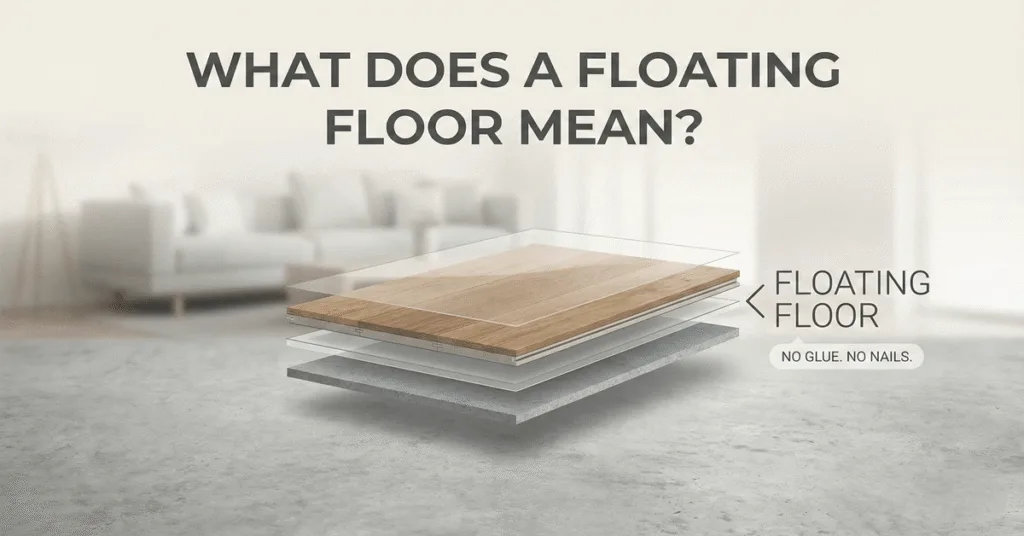
A “floating” floor does not float at all, it locks together and rests on the subfloor without nails or glue. If you’re asking what does a floating floor mean, it means the planks or tiles connect to each other, sit on underlayment, and move as one panel with an expansion gap at the walls. This is the core idea behind click-lock laminate, luxury vinyl plank (LVP), and many engineered hardwood systems.
This matters when you plan a remodel, compare quotes, or try to fix a floor that feels noisy or uneven. Small details like subfloor flatness, moisture on a concrete slab, a vapor barrier, and tight door transitions can decide whether the floor stays quiet or starts to gap, peak, or buckle. You’ll learn what “floating” signals in product specs, where it works best, and what setup steps keep the install stable and clean.
Meaning of “floating floor” and what it’s not
A floating floor is a flooring installation method where planks or tiles lock together and rest on an underlayment over the subfloor, with no nails, staples, or full-spread adhesive holding it down. The floor acts as one “floating” panel, and baseboards or quarter round hide the expansion gap at the walls. You will see this setup with click-lock laminate, luxury vinyl plank (LVP), and many engineered hardwood products.
People hear “floating” and picture a loose floor that shifts underfoot. That is not the idea. The floor stays in place from its own weight, tight joints, and clean transitions at doorways.
“Floating” does not mean waterproof, soundproof, or zero-prep. Water resistance comes from the wear layer, core, seams, and edge treatment, plus good moisture control on concrete. Sound control comes from the underlayment rating, the subfloor, and the room below.
So why call it floating? The planks connect to each other, not to the subfloor. That small detail changes how the floor moves with seasonal humidity and temperature.
Floating floor vs “floating floor” in soundproofing
The phrase “floating floor” can mean two different systems: a standard click-lock floor that is not fastened to the subfloor, or an acoustic floating floor built to cut vibration and footfall noise. The words match, yet the goal, materials, and build detail are not the same. Are you talking about a new LVP install in a bedroom, or a sound-isolation build for a studio?
In home remodeling, most people mean the first one: a manufactured floor that “floats” over foam or cork underlayment. In audio and construction, the term often points to a decoupled floor that sits on resilient pads or isolators to reduce impact noise (IIC) and airborne sound (STC).
Residential flooring (click-lock / tongue-and-groove)
A residential floating floor uses a locking joint like click-lock, drop-lock, or tongue-and-groove, then sits on a foam, felt, cork, or rubber underlayment. Many product lines from Pergo, Mohawk, Shaw, COREtec, Armstrong, and Lifeproof use this approach, though each brand sets its own rules for underlayment, moisture barriers, and transitions.
The floor needs space to move. Installers leave an expansion gap at walls, around pipes, and near fixed objects. Trim covers the gap, yet trim should not pinch the floor.
A common mistake is “pinning” the floor. Heavy kitchen islands, fixed cabinets, or a tight transition strip can trap the floating panel and lead to peaking, buckling, or joint stress. A good installer plans the layout around those pinch points.
Acoustic floating floors (studio/theater isolation, resilient mounts)
An acoustic floating floor is a sound and vibration control assembly, not a click-lock product choice. The build uses resilient mounts, rubber isolators, neoprene pads, mineral wool, or specialty acoustic mats to decouple the finished floor from the structure.
This system often follows a mass-spring-mass idea: a heavy layer sits on a resilient layer, and the structure stays separate. Builders may use plywood layers, a gypsum topping, or a lightweight concrete topping over isolation pads. The goal is less structure-borne vibration, not fast DIY install.
This is why the same phrase causes confusion. A click-lock laminate floor can still sound hollow if the subfloor has dips or the underlayment is wrong. A true acoustic floating floor targets that problem with a different build method.
A clear way to keep terms straight: a residential floating floor is a product install style; an acoustic floating floor is a sound-control assembly. With that in mind, the next step is to know which materials can float in the first place.
Which flooring types can be installed as floating floors
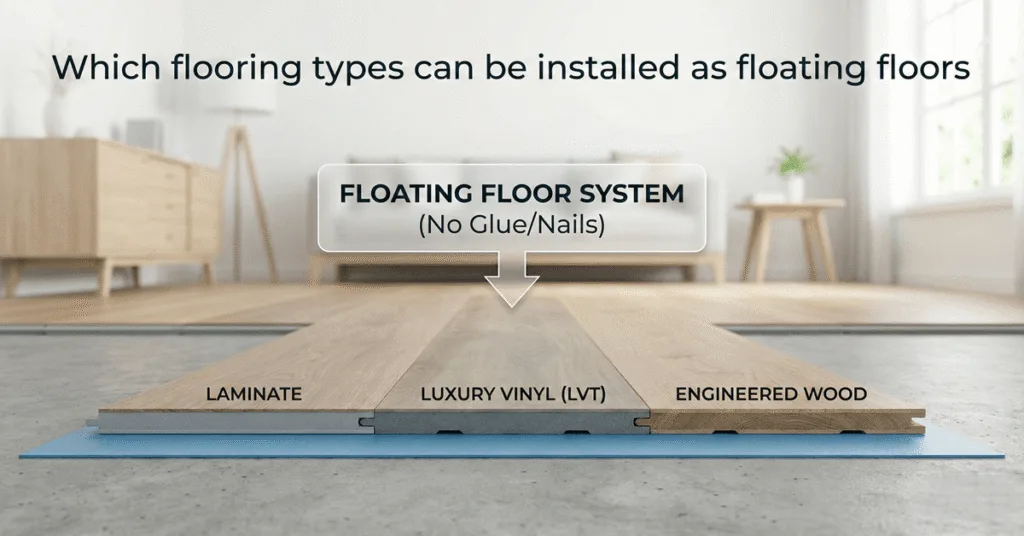
Many modern floors can be installed as a floating floor when the planks or tiles use a locking joint, and the manufacturer allows a non-fastened install over an underlayment.
Laminate flooring, LVP/LVT, many engineered hardwood lines, and some bamboo products fit this category. If you’re deciding between soft flooring and a floating wood-look option, compare engineered hardwood vs carpet for daily comfort and resale. Solid hardwood usually needs nail-down or glue-down, and traditional ceramic tile needs mortar and grout, not a floating click system.
Floating installation changes how you shop. You focus on the joint type, the core (HDF, SPC, WPC, plywood), the underlayment spec, and the subfloor rules. You also check limits for room size, temperature swings, and fixed cabinetry.
Here is a quick map of common materials and what “floating” often means in practice:
| Flooring material | Can it be a floating floor? | Common joint system | Common subfloors | Notes that change the outcome |
| Laminate (HDF core) | Yes | Click-lock, drop-lock | Plywood/OSB, concrete | Moisture control matters on slabs; seams can swell from standing water |
| LVP/LVT (SPC or WPC core) | Yes | Click-lock | Plywood/OSB, concrete, existing hard surfaces | Great for basements when rated for it; soft subfloors can feel springy |
| Engineered hardwood | Often yes (product-by-product) | Click-lock or tongue-and-groove | Plywood/OSB, some slabs | Humidity control still matters; many lines limit install over wet slabs |
| Bamboo (engineered) | Often yes (product-by-product) | Click-lock or tongue-and-groove | Plywood/OSB, some slabs | Density varies by brand; check acclimation and humidity targets |
| Solid hardwood | Rare | N/A | Plywood/OSB | Most installs use nail/staple; floating systems are uncommon |
| Floating tile systems | Sometimes | Interlocking base panels | Flat, stable subfloors | Not the same as mortar-set ceramic; product rules are strict |
Click-lock vs glued-edge floating systems
Click-lock floating floors use a mechanical joint that snaps or angles into place, so the planks hold tight without glue along the seam. This is common in laminate, SPC vinyl, and many engineered hardwood lines. It speeds up install and makes plank replacement easier when you can unlock back to the damaged area.
Glued-edge floating floors use adhesive at the tongue-and-groove seam, then the assembled floor “floats” as one sheet. Some laminates and some engineered wood products use this approach. The glued seam can feel tighter, yet repairs can take more time since planks do not unlock cleanly.
A simple way to choose: click-lock fits most DIY work and fast remodel timelines. Glued-edge can suit rooms where the maker wants a bonded seam, yet the product manual rules the call.
Rooms and subfloors where floating floors are most common
Floating floors show up most in living rooms, bedrooms, hallways, and finished basements, since the installation is fast and clean on many subfloors. If you’re choosing a bedroom surface, see laminate vs carpet comfort and noise trade-offs.
LVP is popular on concrete slabs and below-grade spaces when the plank is rated for that use. Laminate is common in dry, stable spaces with good humidity control.
Subfloor type matters more than many people expect. Plywood and OSB work well when they are flat and solid. Concrete works well when moisture is tested and the correct vapor barrier or underlayment is used.
What about radiant heat? Many SPC vinyl and some engineered wood products allow installs over radiant systems, yet the system needs stable temperature control and the floor needs a compatible rating. If your room has wide spans, heavy fixed cabinets, or frequent wet spills, a floating install may not be the best match.
Next comes the setup that keeps a floating floor stable: subfloor prep, underlayment choice, moisture control, and expansion gaps.
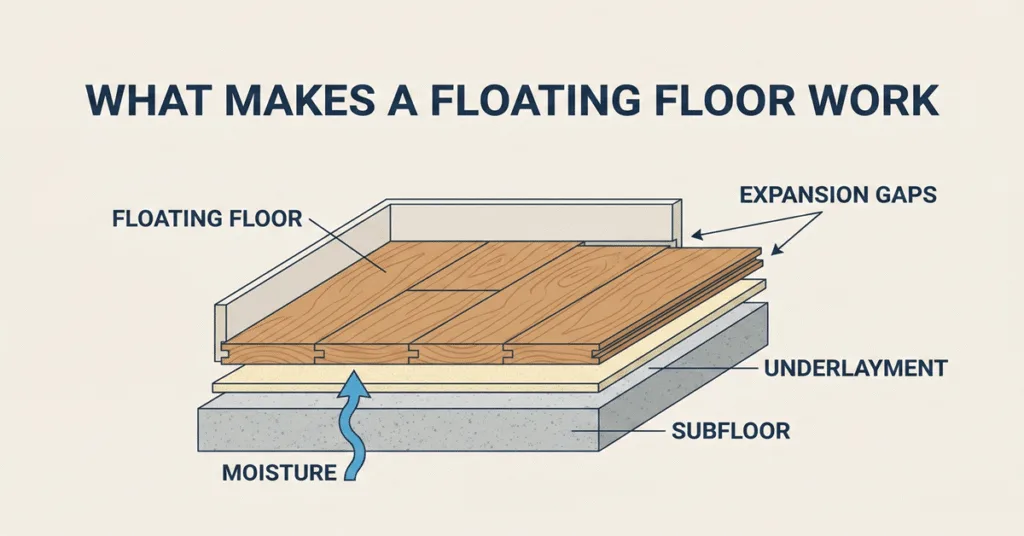
What makes a floating floor work: subfloor, underlayment, moisture, and expansion gaps
A floating floor performs well when four parts line up: a flat subfloor, the right underlayment, safe moisture levels, and a clear expansion gap around the room. Click-lock laminate, LVP, and engineered wood move as one sheet, so small mistakes can travel and show up as noise, gaps, or buckling. Get these basics right, and the floor feels solid, quiet, and predictable.
Most complaints trace back to the same root causes: low spots, high seams, trapped moisture in a concrete slab, or trim that pins the floor in place. Want the simplest way to avoid a callback? Treat prep as part of the flooring, not a separate chore.
Subfloor prep (plywood/OSB vs concrete)
Subfloor prep means you create a clean, dry, flat surface that matches the flooring brand’s limits for flatness, moisture, and deflection. Plywood and OSB need tight fasteners and smooth seams; concrete needs moisture control and a surface that is free of dust, paint, and soft patches. A floating floor hides fasteners, not flaws.
On plywood/OSB, start with a walk test. Listen for squeaks and watch for bounce near joists. Drive screws into loose areas, then scrape off dried mud and paint drips.
Check flatness with a 6–10 ft straightedge or a long level. Mark high spots with painter’s tape. Sand ridges and fill low spots with a floor patch made for your substrate.
On concrete, clean matters. Vacuum well and remove old adhesive, overspray, and chalky dust. A thin film can stop underlayment from lying flat and can create a hollow sound.
Moisture is the make-or-break factor on a slab. Many brands call for a vapor barrier and a moisture test, such as ASTM F2170 in-situ RH or ASTM F1869 calcium chloride. Some installers use a pinless moisture meter as a quick screen, then confirm with the test method named in the warranty.
If the slab has cracks, treat them the way the flooring maker tells you. Some products want crack isolation rules; some do not. Follow the written install guide for your exact plank line.
Quick flatness check (5 minutes)
- Put a straightedge in several directions across the room.
- Circle dips and ridges with chalk.
- Focus on doorways, seams, and around old floor patches.
- Recheck after patching and sanding.
Underlayment types and what each one does (sound, cushion, moisture)
Underlayment is the layer between subfloor and floating planks that manages sound, feel, and moisture needs. Foam, cork, rubber, felt, and attached pads all behave differently, and the wrong match can void a warranty. The best choice is the one your flooring maker names for your subfloor and room.
For many laminate floors, underlayment supports the joint and tames the “tap” sound. Some laminates need a separate foam pad; others have a pad attached and do not want a second layer.
For LVP/LVT, thickness can backfire. A pad that feels soft can let click joints flex, then fail at the seams. Many vinyl brands cap pad thickness and density for that reason.
For engineered hardwood floating installs, underlayment can reduce noise and minor grit, yet it cannot fix a wavy subfloor. Wood still needs stable indoor humidity and a solid, flat base.
Moisture control varies by layer. On a slab, many installs call for 6-mil polyethylene sheeting or an approved vapor barrier underlayment, with seams taped. On wood subfloors, a vapor barrier may trap moisture in the wrong direction, so follow the product guide.
What underlayment does well
- Lowers footfall noise and room echo (sound transmission changes by product)
- Smooths tiny grit and minor texture
- Adds a small cushion, within brand limits
- Adds a moisture layer when approved for concrete
Underlayment decision cues
- Concrete slab + laminate: vapor barrier layer is common.
- Click-lock vinyl: thin, firm, approved pad is common.
- Attached-pad planks: no extra pad is common.
Common underlayment choices (at-a-glance)
| Underlayment type | Typical use | Strength | Watch-outs |
| Foam (PE/PU) | Laminate, some engineered | Affordable, easy roll-out | Too thick can stress click joints |
| Cork | Engineered, some laminate | Good feel, decent sound control | Cost; needs flat subfloor |
| Rubber | Sound control builds | Strong sound reduction | Height change at doors; cost |
| Felt | Some vinyl/engineered | Firm support, smooths grit | Must be approved for your plank |
| Vapor barrier film | Concrete slab setups | Moisture control | Seam taping and overlap matter |
Expansion gaps, transitions, and why baseboards matter
Expansion space is the planned clearance at walls and fixed objects that lets a floating floor grow and shrink with temperature and indoor humidity. That gap, plus the right transition strips, prevents peaking, buckling, and noisy rubbing. A floating floor needs room to move; trim should cover the gap, not crush it.
Leave the expansion gap the brand calls for, often around the full perimeter, at door frames, around pipes, and near fireplaces or island bases. Use spacers during installation. Remove spacers before trim goes on.
Transitions matter in hallways and long runs. A floating floor may need a T-molding, reducer, or end cap at doorways and at changes in height. Many brands set a max run length before they want a break; check the spec sheet for your plank line.
Baseboards and quarter round can cause hidden trouble. If nails pin the plank edge, the floor can no longer slide. Keep fasteners in the wall trim, not through the flooring.
Signs the floor is pinned
- Planks peak near a wall a few days after installation
- Creaks show up at doorways
- Gaps open in one area and close in another
A simple self-check helps: can you slide a thin card under the baseboard without catching the plank edge? If not, the trim may be tight.
Next, you’ll see how floating installs compare with glue-down and nail-down methods, so you can pick the right build for your room and your budget.
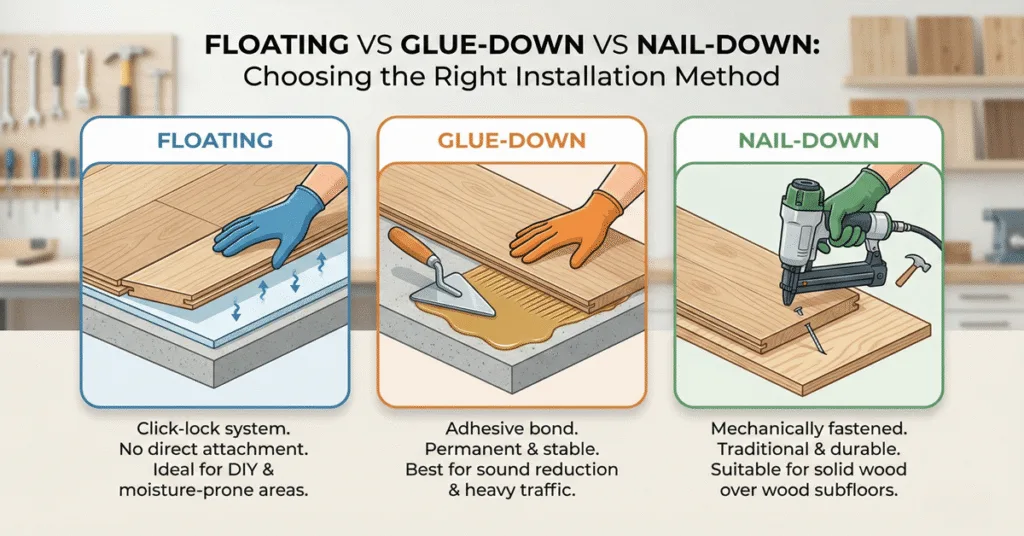
Floating vs glue-down vs nail-down: choosing the right installation method
Floating, glue-down, and nail-down are three installation methods that change how a floor feels, sounds, and holds up over time. A floating floor locks together and rests on underlayment; glue-down bonds planks to the subfloor with flooring adhesive; nail-down fastens wood to plywood with cleats or staples. The best method matches your material, your subfloor, and your daily use. If budget is driving the decision, compare installed carpet vs LVP price ranges before you commit to a product line.
Most people want a clear answer to one question: “Which method gives me the fewest problems in my space?” Use the comparison below, then map it to your room conditions.
Method comparison table
| Factor | Floating (click-lock) | Glue-down | Nail-down |
| Typical materials | Laminate, LVP, engineered wood | LVP/LVT, engineered wood, some solid | Solid hardwood, some engineered |
| Subfloor fit | Works on wood or concrete | Works on wood or concrete | Needs wood subfloor (plywood/OSB) |
| Feel underfoot | Can feel slightly softer | Often feels firm | Often feels firm and “wood solid” |
| Noise profile | Can sound hollow if prep is weak | Often quieter | Can squeak if subfloor is loose |
| Repair style | Replace planks by unlocking rows | Spot repairs vary by product | Board replacement can be surgical |
| DIY friendliness | High | Medium | Low to medium |
| Moisture risk | Concrete needs strong moisture plan | Adhesive can fail with moisture | Wood movement risks need control |
| Long-run stability | Good with flatness + gaps | Very stable when done well | Very stable on a solid wood base |
Best-fit scenarios (DIY, rentals, quick remodels, uneven schedules)
A floating floor fits best when you want speed, clean work, and a system that you can change later without tearing up adhesive. Click-lock laminate and LVP suit many DIY projects, rentals, and rooms where downtime matters. You can stage the work in parts, then walk on it fast once rows lock.
Rentals and resale projects often favor floating installs. If you’re balancing upfront spend vs replacement cycles, this breakdown on when carpet costs less than hard flooring can help you sanity-check the numbers.
The method keeps the subfloor in better shape, and plank swap-outs stay realistic. A damaged LVP plank in a hallway is a headache, yet it is usually fixable without sanding the whole room.
Floating floors also help when your schedule is broken into short windows. You can prep one day, lay underlayment another day, then click planks on a weekend. Glue-down work often needs cure time and careful trowel timing.
Ask yourself a practical question: do you want the option to lift the floor later for a plumbing fix or a subfloor repair? Floating systems make that job far less messy.
When floating is the wrong choice (heavy fixed cabinets, extreme moisture, large open spans)
A floating floor is a poor fit when the floor gets trapped under heavy fixed loads or pinned by built-ins. Kitchen base cabinets, stone islands, and some vanities can stop the floor from moving. That stress can break click joints or cause peaking near the load line.
Moisture-heavy spaces can push you toward glue-down vinyl or a different material choice. If cost is still a factor, compare vinyl vs carpet lifetime expenses (materials, install, and long-run upkeep).
Basements with damp slabs, rooms with frequent wet mopping, and homes with big humidity swings raise the risk of edge swell in laminate and joint stress in some vinyl cores. A moisture plan can help, yet some rooms call for a method that stays stable under tough conditions.
Large open spans can strain a floating install. Many brands set limits on run length and room width without a transition break. If your plan is a wide-open living area that runs through multiple doorways, check the spec for expansion joints and max span.
Glue-down fits well when you want a firmer feel and you have the skill to manage adhesive spread, open time, and rolling. Nail-down fits well for solid hardwood on plywood, with a tight subfloor and stable indoor humidity.
A good next step is simple: match your room and subfloor to the product’s install method list before you buy. The next part of the guide walks through the installation steps at a high level, so you can picture the work from prep to trim.
How a floating floor is installed (high-level steps you can visualize)
A floating floor installation creates one locked-together surface that rests on underlayment over a prepared subfloor, with an expansion gap at walls and fixed objects. This is how click-lock flooring works for laminate flooring, luxury vinyl plank (LVP), and many engineered hardwood products. For bedrooms specifically, here’s a practical guide on carpet warmth vs LVP easy-clean living.
The install succeeds when the subfloor is flat, moisture risk is controlled, and transitions do not pinch movement.
Read the manufacturer’s installation guide for your exact product and lock type (angle-angle, drop-lock, fold-down). It will state subfloor flatness limits, concrete slab moisture limits, vapor barrier rules, and maximum run length before a transition strip.
Step-by-step sequence
A floating flooring install follows a simple path you can picture: prep the base, lay the layers, lock rows, finish edges. The goal is a straight first row, tight joints, and free movement at the perimeter.
- Stage the cartons. Bring boxes into the room for the time listed by the brand, then check planks for damage and matching lot numbers.
- Remove shoe molding. Plan to cover the expansion gap with baseboard or quarter round without pressing on the floor.
- Verify subfloor flatness. Use a 6–8 ft straightedge to find dips and ridges, then patch low spots and sand high points.
- Check moisture on concrete. Use a flooring-approved moisture test (calcium chloride kit or in-slab RH probe). Add the required vapor barrier under a floating floor on a slab.
- Lay underlayment for floating floors. Roll it out flat, tape seams, and avoid overlaps that create ridges.
- Plan layout. Choose plank direction, measure the room, and avoid a narrow last row by shifting the start line.
- Undercut door jambs. Use an oscillating multi-tool and a scrap plank so the floor slides under the trim without binding.
- Set the first row. Use spacers, keep the row straight, and lock end joints cleanly.
- Build rows with a stagger. Follow the brand’s minimum offset, lock long edges, then close end joints with a tapping block if needed.
- Finish transitions and trim. Install transition strips and T-molding at doorways, then reinstall trim to cover gaps without clamping.
Tools and materials people actually use (by flooring type)
Floating floor installation tools protect the click-lock joint and keep rows straight. Laminate and engineered wood need clean saw cuts, and LVP needs sharp blades for clean scoring.
- All floating floors: tape measure, chalk line, straightedge, spacers, pull bar, tapping block, rubber mallet, utility knife, safety glasses, knee pads
- Laminate: laminate cutter or miter saw, jigsaw for notches, vacuum for dust
- LVP/LVT: heavy-duty utility knife blades, vinyl cutter (optional), hand roller (optional)
- Engineered hardwood (click systems): miter saw with fine blade, jigsaw, pull bar, and tapping block suited to wood profiles
Critical “gotchas” that cause callbacks (first-row straightness, door jamb cuts, transitions)
Most floating floor problems start at pinch points, uneven subfloor areas, or weak transitions. If you’re laying LVP yourself, scan this checklist of vinyl plank install errors to avoid before you lock the first row. One tight doorway can trigger popping noises, joint gaps, or peaking.
Baseboard, quarter round, and door trim must cover the expansion gap and still leave the floor free to move. Transitions must not trap the planks under the molding channel. Watch kitchens with heavy cabinets, islands, and long open runs, since trapped movement can cause a buckling floating floor.
A clean install sets up easier troubleshooting, since you can trace issues back to moisture, flatness, or a pinch point.
Common floating floor problems and how to diagnose them
Floating floor issues show up as a hollow sound, clicking, gaps, edge lift, peaking, or buckling, and the cause is often subfloor flatness, moisture, underlayment, or blocked expansion space. Laminate, LVP, and engineered wood share the same installation method, yet each material reacts differently to water and movement. Diagnosis works best when you locate the symptom, then check the nearest doorway, wall edge, and transition.
Ask two quick questions. Does the issue repeat in the same spot, or does it happen everywhere? Did it start after a season change, a leak, or a new appliance move?
Quick diagnosis table (symptom → likely cause → fast check → fix level)
| Symptom | Likely cause | Fast check | Fix level |
| Popping or clicking when walking | Tight expansion gap, bound transition, damaged click joint | Check doorways and baseboards for pinched edges; inspect nearby joints | Trim or transition adjustment; pro help if joints are crushed |
| Hollow sound laminate floor or LVP | Subfloor dip, soft underlayment, uneven support | Walk and mark soft zones; check with a straightedge | Patch low spots; pro help if widespread |
| Squeaks | Subfloor movement under underlayment | Listen near seams on wood subfloor; look for loose panels | Re-screw subfloor if accessible; pro help if large |
| End-joint gaps opening | Broken lock, poor row alignment, rolling loads | Inspect tongues and tabs for chips; check if gaps return after tapping | Re-lock if minor; plank replacement if lock is broken |
| Peaking or buckling | Moisture swell, trapped expansion, slab moisture | Look near walls, columns, transitions; review recent water exposure | Address moisture source first; pro help is common |
| Edge lifting near perimeter | Trim or transitions pressing on the floor | Remove a short trim section and test movement | Reset trim; replace damaged planks if warped |
Noise and “hollow” feel: what’s normal vs a problem
A floating floor can sound louder than nail-down wood, since the panel rests on underlayment and may bridge small dips. Laminate with an HDF core can amplify tapping sounds, and thinner LVP can sound sharp in large empty rooms.
A problem noise repeats in the same place and grows over time. Check the closest transition strip first. Lift the cover and look for a tight fit that blocks movement under T-molding.
Underlayment choice matters. Extra-soft foam can let joints flex and click. A denser sound reduction underlayment can lower footfall noise, yet it still needs a flat subfloor.
Buckling/peaking: moisture and expansion pinch points
Peaking looks like a raised ridge along seams or a tent shape across a run. Laminate swells fast when water reaches the core. Engineered hardwood can cup or crown with humidity swings. LVP is water resistant, yet it can still peak when the floor panel gets trapped.
Check the perimeter first. Remove a small piece of shoe molding and confirm a clear expansion gap with no nails, paint bridges, or debris. Then check tight zones: around pipes, sliding doors, and narrow doorways.
On concrete, moisture is a common cause. Use moisture test concrete slab flooring methods approved by the brand, then confirm you used the right vapor barrier under a floating floor. Look for fridge water lines, wet mopping, plant trays, and exterior door leaks.
Separating planks and edge lifting: joint damage vs subfloor movement
Plank separation often points to a damaged click-lock joint, a row that did not lock fully, or flex from a dip under the joint line. End-joint gaps that reopen after you tap them closed often mean the locking tab snapped.
Edge lift near a doorway often ties to a bound transition or a jamb cut that pinches. Remove the transition cover and test if the floor can slide slightly. If it cannot, relieve the pinch, then repair the joint.
Once you identify the cause, care and repair become straightforward and less costly.
Care, repairs, and expected lifespan of a floating floor
A floating floor lasts based on wear layer strength, core stability, and joint durability under traffic, humidity, and cleaning habits. Laminate lifespan often depends on seam protection and water control. LVP lifespan often depends on wear layer thickness (mils) and joint strength. Engineered hardwood lifespan depends on veneer thickness, finish quality, and steady indoor humidity.
Daily grit is a quiet destroyer. Sand and fine dirt scratch finishes and wear layers. Use mats, felt pads, and a vacuum set for hard floors.
Water control matters most at seams and edges. Use a damp microfiber mop, not a wet mop, and wipe spills quickly. Skip steam mops on laminate and on many engineered wood finishes, since heat and moisture can damage joints and veneers.
Can you replace one plank in a floating floor?
Plank replacement floating floor repairs are possible, and the method depends on the plank location and the locking system. Most click-lock floors require you to unlock back to the damaged plank, swap it, then re-lock rows. A center-room plank can be cut out and replaced by a pro, then secured with adhesive at the edges.
Before you start, check your spare planks and lot number. Matching batches helps color and embossing match. Ask yourself if the damaged plank sits near a wall, since that makes a re-lock repair much easier.
A safe DIY approach for many floors:
- Remove shoe molding on the nearest wall.
- Unclip planks row by row back to the damaged plank.
- Replace the plank, then re-lock rows in the same direction as the original install.
- Reinstall trim so it covers the expansion gap without pressing on the floor.
How to extend lifespan (humidity, mats, chair glides, cleaning routines)
Stable indoor conditions reduce gaps and edge stress. Engineered wood likes steady humidity, and winter air can open joints. Laminate needs dry seams, since repeated water exposure can swell the core.
Use a simple routine that fits the surface:
- Vacuum or sweep often with a soft brush head.
- Clean with a pH-neutral cleaner approved by the flooring brand.
- Use chair glides and chair mats for rolling chairs.
- Refresh felt pads before they trap grit.
Keep receipts, box labels, and install photos for warranty support. Many warranties mention joint separation, wear, staining, and moisture damage.
Good care keeps the surface tight and quiet, and it makes future diagnosis much easier when a new sound or gap shows up.

Frequently Asked Questions
What does it mean when flooring is “floating”?
A floating floor is an installation method where the planks or tiles lock together and rest on underlayment, not fasteners. The floor “floats” over the subfloor as one panel, with an expansion gap at walls and door frames. Baseboards and transition strips cover the gap, so the floor can move with temperature and humidity.
Is laminate flooring always a floating floor?
Most laminate flooring installs as a floating click-lock system, so people often treat “laminate” and “floating floor” as the same idea. Some laminate products use glued-edge joints, yet they still float over underlayment. Always check the manufacturer install guide, since a few specialty systems call for adhesive in seams or at edges.
Can you install a floating floor over concrete?
Yes, many LVP, laminate, and engineered wood products can float over a concrete slab if the slab is flat, clean, and dry. Moisture matters most, so builders often run an ASTM RH test or calcium chloride test before install. If the slab fails, the floor can cup, gap, or peak. Have you seen that before?
Do floating floors need underlayment or a vapor barrier?
Most floating floors need an underlayment for cushioning, minor sound control, and joint support, unless the plank has an attached pad. A vapor barrier often matters on concrete or below-grade spaces, using polyethylene film or a rated underlayment. Product specs decide the exact stack: subfloor, moisture layer, underlayment, then the floating planks.
How much expansion gap should you leave for a floating floor?
Many manufacturers call for about 1/4 inch to 1/2 inch expansion gap around walls, pipes, and fixed posts, then wider gaps for large rooms. The goal is free movement, not a tight “pinch” under baseboards or door jambs. Use spacers during install, then cover gaps with baseboard and quarter round.
Why does my floating floor sound hollow or make popping noises?
Hollow sound often comes from a thin underlayment, a hard concrete slab, or small dips in the subfloor that let planks flex. Popping or clicking can point to tight spots at transitions, missing expansion space, or debris in a click-lock joint. A quick test helps: do the noises cluster near a doorway or heavy furniture?
Can kitchen cabinets or a heavy island sit on a floating floor safely?
Most floating floor brands do not want fixed cabinets or a heavy island sitting on top, since the weight can trap the floor and block expansion. Some systems allow it with a build-out, expansion breaks, and approved transitions, but the install guide must say so. If you ignore this, you may see peaking near toe-kicks and seams.
Conclusion
A floating floor uses interlocking planks or tiles that rest on underlayment over a subfloor, with perimeter expansion gaps and transition strips for movement. The setup works for laminate, luxury vinyl plank (LVP), and many engineered wood products when the surface is flat, moisture stays in range, and the floor is not pinched by trim.
If you came here asking what does a floating floor mean, the real takeaway is the install method, not the material name. Read the manufacturer’s instructions, then choose the right underlayment, vapor barrier plan for concrete, and clean transitions at doorways. Ready for your next step? Check your subfloor flatness and moisture, then compare product specs before you buy or start cutting planks. For more room-by-room comparisons and install guides, browse more flooring articles here.