Disclosure: Classy Floor is reader-supported. As an Amazon Associate, we earn from qualifying purchases. We may also earn commissions from other affiliate programs, at no additional cost to you. Learn more →
Which flooring choice fits the space and the program, not just the finish? Broadloom carpet vs carpet tiles comes down to how broadloom carpet and modular carpet work with the subfloor, seam tape, pressure-sensitive adhesive systems, and underlay choices. A corridor, an open office, and a meeting room punish flooring in different ways, so the right answer changes by constraint.
Facilities teams, designers, and owners face a practical call on downtime, repair plans, and how commercial carpet flooring will look after heavy use. This guide makes that choice clearer with a space-fit checklist, a cost comparison that goes past price per square meter, and plain installation notes, including subfloor preparation and seam visibility. A common mistake is treating broadloom carpet vs carpet tiles for office spaces like a simple quote check and missing waste, labour, and future swaps of carpet squares.
Broadloom carpet vs carpet tiles: fastest way to choose by space and constraints
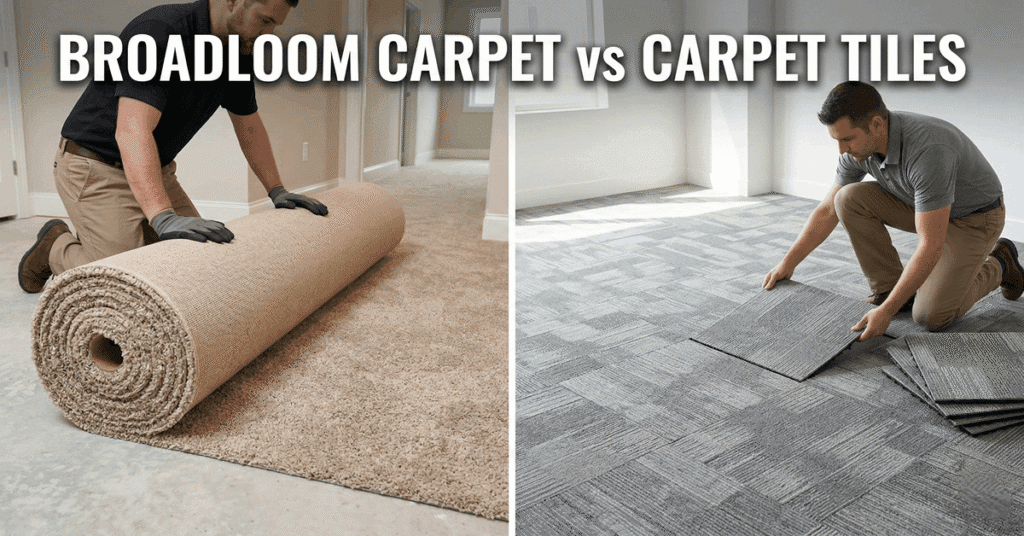
Broadloom carpet suits spaces that need a continuous wall-to-wall carpet look, quieter footfall with underlay, and fewer visible joins across the main field. Carpet tiles suit spaces that need phased work, fast local repair, and simple swaps after spills or wear. The choice links directly to the subfloor, pressure-sensitive adhesive systems, seam tape, seam visibility tolerance, and how the area will be used day after day.
Space fit map (commercial and residential)
Broadloom carpet often lands well in meeting rooms, hospitality spaces, and larger living rooms where a single visual field matters, and choosing the right carpet underlay adds comfort. Carpet squares often win in open plan offices, classrooms, and corridors where commercial carpet flooring faces rolling loads, dirt lanes, and frequent spot damage. Stairs and tight turns can favour broadloom carpet, since how stair carpet is wrapped, and patterned alignment across small cuts, can look cleaner than a tile grid.
| Space or use case | Broadloom carpet tends to suit when | Carpet tiles tend to suit when |
| Open plan offices | A seamless field matters more than quick swaps | Quick access for spot replacement matters |
| Corridors and circulation | Patterning can run long with planned seams | Wear lanes and damage call for easy swaps |
| Classrooms and training | Underlay comfort and quieter steps matter | Spills and scuffs need local replacement |
| Hospitality rooms and suites | A continuous finish and comfort matter | Room-by-room refresh cycles matter |
| Bedrooms and family rooms | Wall-to-wall carpet feels and fewer joins matter | Rental turnover and quick fixes matter |
Constraint triggers that usually decide it
Start with the building program. If you are planning around access and handover, a realistic carpet installation timeline helps set expectations early. A full shutdown supports broadloom carpet installation across large zones with planned seams and clean transitions. Occupied sites often steer toward modular carpet tiles, since tiles can go down in phases, and a damaged tile can come up without cutting out a large field.
Next, check the floor buildup. Door clearances, thresholds, and transitions change fast when underlay enters the stack. Broadloom carpet paired with underlay can lift the finished height. Carpet tiles usually run thinner, yet backing choices still change the final level.
Then focus on the subfloor. A flat, sound base makes both systems look better, yet uneven spots show sooner with tiles, since corners can telegraph the surface. Vendor documentation often calls out site checks for moisture and flatness; those checks matter most on concrete slabs and raised access floor panels.
Last, judge visual tolerance. Broadloom carpet seams can hide well with good seam placement, yet poor placement shows at the doorway and across sight lines. Carpet tiles reduce seam length per piece, yet the grid can read in bright light or long corridors. If the brief demands a near-seamless look, broadloom carpet usually gives a cleaner field.
Broadloom carpet vs carpet tiles: total cost of ownership, not just price per square meter
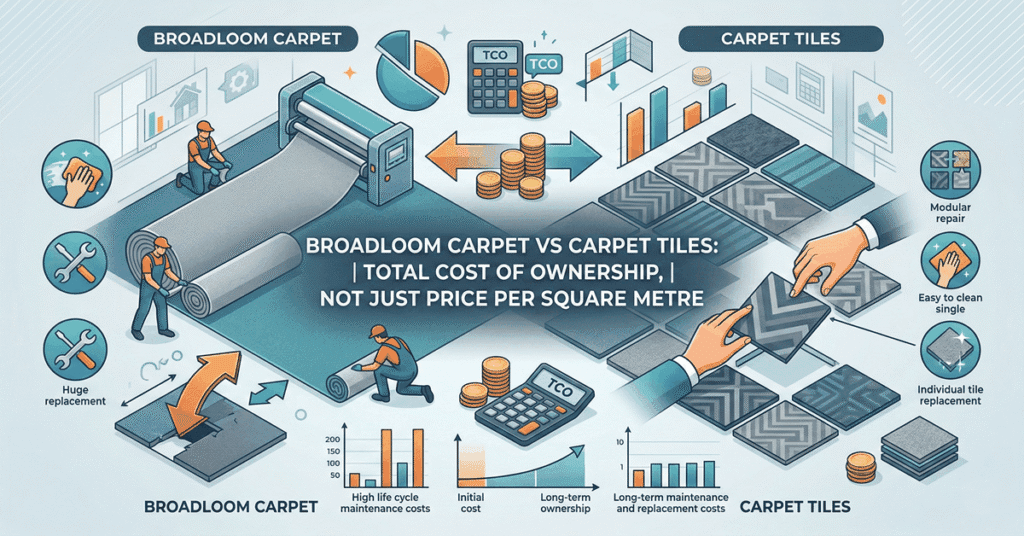
Total cost of ownership for broadloom carpet and carpet tiles is driven by waste, labor, downtime, and repair events, not the first line item on a quote. Broadloom carpet can look competitive on material price per square meter, yet seam tape work, pattern matching, roll-width waste, and carpet construction differences can change the installed total. Modular carpet often carries a higher material rate, while pressure-sensitive adhesive systems and future swap-outs can lower disruption and repair spend in commercial carpet flooring.
A fair comparison starts by forcing both options into the same scope. Ask for the same subfloor condition, the same removal and disposal assumptions, and the same transition details. Industry guidance and vendor documentation often flag that subfloor readiness and moisture testing can change prep work and schedule, so those conditions belong in the model.
Cost drivers that flip the result
Broadloom carpet costs swing on roll width, room shape, seam planning, and comparing nylon and polyester fibres when durability targets matter. Carpet tile costs swing on tile layout, cut losses at perimeters, and the adhesive choice. The biggest flips usually come from a small group of variables:
| Cost driver | Broadloom carpet impact | Carpet tiles impact | What to capture in quotes |
| Material waste factor | Offcuts rise in small rooms, angled walls | Perimeter cuts have less impact on odd shapes | Waste percentage assumption |
| Installation labor | Seaming and pattern alignment take time | Faster in many spaces, still labor at cuts | Labor rate and crew size |
| Downtime cost | Often needs larger clear zones | Supports phased work in zones | Work hours and phasing plan |
| Repair events | Patching and re-seaming can be visible | Single tiles can be swapped | Repair method and response time |
| Spares strategy | Reserved roll stock is harder to store | Keep a carton of carpet squares | Quantity and storage plan |
A simple rule: spaces that need phased replacement tend to favor carpet squares, while spaces where seamless visuals matter may favor wall-to-wall carpet, even when the labor line grows.
Cost drivers that flip the result
The most common budgeting error is treating “installed cost” as a single number and skipping the next five years. A corridor with rolling loads can suffer edge wear at seams, which can trigger re-seaming or patching. A breakroom with frequent stains can create repeated repair events, where swapping tiles stays contained to the affected area.
Use two time horizons in the same table: a 5-year view for cleaning cycles and early damage, and a 10-year view for larger refresh decisions. The inputs stay plain: expected service life, maintenance frequency, and how many repair events the site can tolerate without disruption.
Cost drivers that flip the result
If a project includes an underlay, capture that cost consistently. Broadloom carpet commonly pairs with underlay, which changes comfort and sometimes the budget. Carpet tiles often rely on backing systems, so the comparison must stay like-for-like on the finished floor build-up and transitions at doorways.
When quotes look far apart, check three lines first: waste factor, labor for seams or perimeter cuts, and the plan for future repairs. Those line items usually explain the gap before any debate about the material price per square meter.

Installation, downtime, and subfloor readiness that specs often ignore
Installation success for broadloom carpet and carpet tiles starts with subfloor preparation and moisture testing, then moves to adhesive selection, seam tape planning, and transition details. Concrete slab conditions, raised access floor panels, and plywood behave differently under pressure-sensitive adhesive and tackifier systems. When the prep work misses the mark, seam visibility, curling, and bond issues show up fast, even when the commercial carpet flooring looks fine on day one.
Broadloom carpet installation often runs on longer runs, seam placement, and pattern matching. Carpet tile installation leans on layout accuracy, adhesive coverage, and clean edges where carpet squares meet door clearances, stairs, and threshold trims. Vendor documentation notes that cure time and site conditions can change the schedule, so downtime planning belongs in the spec, not in the last-minute install meeting.
Pre-install checklist (spec critical)
Use this checklist before material hits the floor. It keeps broadloom and modular carpet on the same playing field during bidding and site walks.
- Verify moisture testing results and document the moisture mitigation plan for the concrete slab.
- Confirm subfloor flatness, then repair low spots, cracks, and loose panels on a raised access floor.
- Confirm acclimatisation plans and target jobsite conditions before adhesive work begins.
- Select pressure-sensitive adhesive or tackifier systems that match the backing system, then confirm cure time needs.
- Map seam tape locations, seam direction, and transition points at doors, stairs, and ramps.
- Confirm underlay use, thickness, and edge build-up at transitions so door clearances stay workable.
Program and phasing
Occupied sites reward a phased plan. A common approach uses a short survey, a measured layout, a staged lift of old material, subfloor repairs, adhesive work, and then a handover check for seams, transitions, and trip edges. That workflow reduces rework and keeps the installation team aligned with the building schedule.
Corridors and stairs bring their own constraints. Seam placement in corridors needs straight runs and predictable transitions, and stair details can drive added downtime when trims and nosings need refit. Raised access floor areas add another layer, since panel movement and edge height differences can telegraph through carpet squares or broadloom seams.
Performance and maintenance in real life: durability, cleaning, acoustics, and indoor air quality
Broadloom carpet and carpet tiles perform well when the subfloor is sound, seam tape work is clean, and pressure-sensitive adhesive systems match the backing. The day-to-day difference shows up in cleaning response, visible wear at seams, drying time after deep cleaning, and indoor air quality tied to VOC emissions. Fibre choice also plays a role, including olefin and PET fibre trade-offs. Modular carpet can limit the impact of stains through targeted swaps, yet broadloom can look more uniform when upkeep stays consistent.
Maintenance reality check
Maintenance success comes from a simple rhythm: frequent soil removal, fast spot response, and periodic deep cleaning with full dry-down. If you are choosing tools, steam cleaning versus extraction helps you match the machine to the mess. Industry guidance and the IICRC S100 cleaning standard for carpet and rugs both point to entry matting and quick spill pickup as the biggest levers for appearance retention. Carpet squares allow planned rotation in heavy paths, which can spread wear without touching the full floor.
| Failure mode | What it looks like | What usually causes it | Practical prevention |
| Edge curl on tiles | corners lift, trip risk | weak bond, dust on subfloor | Keep spare cartons or reserved roll stock |
| Seams show early | lines appear, fray starts | poor seam work, wheel traffic | seam placement planning, protect caster zones |
| Rapid re-soiling | dark paths return fast | poor vacuuming, no matting | daily vacuum, entry matting |
| Odor after cleaning | smell lingers | slow dry-down, over-wetting | controlled water use, faster dry time |
| Patch mismatch | swapped area stands out | no attic stock, dye lot shifts | Dark paths return fast |
Comfort and acoustics trade-offs
Underlay under broadloom can improve foot comfort and help with acoustic performance, mainly in meeting rooms and corridors. Carpet tiles can reach similar comfort with cushioned backing, yet seams and backing stiffness can affect rolling loads from chairs and carts. For indoor air quality, the CRI Green Label Plus low emissions program and vendor documentation help confirm VOC expectations for the chosen product line.

Frequently Asked Questions
Are carpet tiles actually cheaper than broadloom carpet once you include installation and waste?
Carpet tiles often reduce waste in small rooms, pillars, and irregular plans, since modular carpet tiles cut around obstacles with less offcut. Broadloom carpet can cost less on large, open rectangles, yet seams, roll widths, and pattern matching can raise waste and labour. A fair quote compares the same subfloor preparation and the same installation method, not just material.
Which lasts longer in high traffic areas: broadloom carpet or carpet tiles?
High traffic corridors punish seams, rolling loads, and grit, so carpet choices for heavy foot traffic can matter as much as the format. Carpet tiles let crews swap damaged carpet squares without lifting the full field, so the floor can stay presentable longer with a spare carton on hand. Broadloom carpet can still perform well, yet a bad seam line or a worn track can be harder to refresh without a visible repair.
Do carpet tiles look “seamless” and can you hide the grid pattern?
Many carpet tiles show a faint grid under raking light, and seams can telegraph on an uneven subfloor. Broadloom carpet hides joins better on wide spans, yet seams still exist, and seam placement matters. Vendor documentation usually calls out layout rules that reduce seam visibility.
What is the best option for offices that need phased refurbishments with minimal downtime?
For broadloom carpet vs carpet tiles for office spaces, carpet tiles usually win when work must happen in zones and overnight. Pressure-sensitive adhesive systems support lift-and-replace without aggressive scraping, and tiles suit raised access floors where future changes happen. Broadloom carpet suits full shut-down installs where a single surface is the goal.
Can broadloom carpet be repaired invisibly, or does damage usually mean full replacement?
Broadloom carpet repairs rely on donor material, seam tape, and skilled seaming. A clean patch is possible, yet colour shift over time can show, and a damaged run in a visible area can stay noticeable. Carpet tiles hide repairs better by swapping single tiles, as long as the dye lot and direction match.
Are carpet tiles better for basements or areas with occasional water vapor risk?
Water vapor through a slab can break adhesive bonds and lead to edge lift in carpet tiles. Broadloom carpet can also fail if the subfloor holds water, even with underlay. Site testing and product guidance set the safe range, so the right choice can change depending on building conditions.
What should I ask for in a quote to compare broadloom and tiles fairly?
Ask for the same scope on subfloor preparation, the exact adhesive system, seam details, and what the installer includes at transitions and doors. Request waste assumptions, spare material planning, and a basic maintenance plan with entry matting systems. Those details explain most price gaps more than the headline rate.
Conclusion
Broadloom carpet and carpet tiles call for a clear choice based on space needs, downtime limits, and what the subfloor can support, not just the finish on the surface. Broadloom carpet suits wide spans where a continuous look matters, while modular carpet supports quick swaps when damage and stains are part of daily use. Pressure-sensitive adhesive systems, seam tape, and underlay choices shape both performance and serviceability.
Seam visibility, pattern matching, and repair planning tend to decide the spec once the layout and program are clear. Subfloor preparation and moisture risk can block an installation method even when the material looks right on paper. Which constraint is non-negotiable on the site?
Use a space-fit checklist and a like-for-like quote scope, then confirm install details in vendor documentation before work starts; that is the fastest path to a confident broadloom carpet vs carpet tiles decision.