Disclosure: Classy Floor is reader-supported. As an Amazon Associate, we earn from qualifying purchases. We may also earn commissions from other affiliate programs, at no additional cost to you. Learn more →
Why do two carpets priced the same wear so differently after a year? In the olefin vs nylon carpet choice, the fiber (polypropylene/olefin vs nylon 6 or nylon 6,6) sets the limits for resilience, oily-soil pickup, UV fade, and moisture behavior. This guide uses CRI Green Label Plus, CRI 104/105, and ANSI/IICRC S100 as reference points, then turns them into plain buying criteria.
Carpet is one of the few finishes you live on every day, and the wrong pick shows up fast on stairs, halls, basements, and sunlit rooms. You will get a quick choice guide, a performance scorecard, and room-by-room picks that match real constraints like pets, spills, and budget. You will leave with a store-ready checklist on carpet density, twist level, pile height, padding, and warranty language.
Olefin vs nylon carpet: quick choice guide
If you want a fast answer, nylon carpet wins for resilience and long-term appearance retention, and olefin (polypropylene) carpet wins for moisture tolerance, UV fade resistance, and budget-friendly coverage. This section frames the olefin vs nylon carpet decision using fiber limits plus spec checks such as carpet density, twist level, pile height, and carpet padding, with indoor air notes like CRI Green Label Plus.
Nylon vs olefin: the 60-second verdict
Nylon (nylon 6 or nylon 6,6) “springs back” better after foot traffic, so it hides matting/crushing longer on stairs and halls, especially compared with polyester carpet in real-world traffic. Olefin is often solution-dyed, so color runs through the fiber and holds up well in bright rooms and many indoor-outdoor settings. Ask yourself: are you paying for a carpet to look “new” longer, or to handle sun and damp spaces with fewer surprises?
Choose nylon if / choose olefin if (at a glance)
| Choose nylon if you want… | Choose olefin (polypropylene) if you need… |
| Better resilience in high-traffic areas and on stairs | Better fit for basements, slab rooms, and humid spots |
| Stronger appearance retention (less flattening) | Strong colorfastness in sun (common with solution-dyed olefin) |
| A wider range of “soft” styles in cut pile (Saxony, textured) | A practical loop pile/Berber look at a lower cost tier |
| Fewer “traffic lane” looks when vacuuming is imperfect | A value pick for rentals or quick refresh projects |
Decision tree: traffic, pets, moisture, sun, budget
Start with the room’s stress. High traffic + stairs points to nylon. Basement + moisture risk points to olefin. Pets + oily soils often points to nylon, since oily soil can cling to olefin and make lanes look dull even after routine vacuuming.
Then check construction. A dense, tight loop olefin can beat a flimsy nylon in the real world. A mid-grade nylon with low density can still show footprints/vacuum marks and flatten fast.
8-question quick checklist (bring to the store)
- Is this room stairs, hall, or entry traffic?
- Does the room sit below grade or on a slab?
- Do you see direct sun for hours each day?
- Do you have pets that leave oily soil trails or frequent spots?
- Is the style loop pile (Berber) or cut pile?
- What are the density/face weight numbers on the tag?
- What is the twist level and pile height for cut pile?
- Is it low-VOC and listed under CRI Green Label Plus?
Common shopper trap: fiber matters less than construction (preview the specs you’ll use later)
Fiber sets the ceiling, yet construction sets day-to-day satisfaction. Dense carpet with a stable backing and the right padding/cushion can slow flattening and keep seams cleaner, and install quality matters too (many installers follow CRI 104/105 principles). Next, the performance chart breaks down where nylon and olefin shine, plus the trade-offs that drive most complaints.

Nylon vs olefin performance comparison chart
The clean way to compare nylon vs olefin carpet is to separate three buckets: appearance retention (resilience and matting), stain behavior (water spills vs oil-based stains), and environment (UV light and moisture). The scorecard below reflects common outcomes seen in homes and in cleaning standards language, such as ANSI/IICRC S100, then ties each rating to a practical “why it matters.”
Durability and resilience: matting/crushing under traffic
Nylon rates higher for resilience, so it handles compression on stairs and halls with fewer flat lanes. Olefin can wear fine in a tight loop pile build, yet it tends to show compression sooner in busy cut-pile looks.
Stain resistance: water-based spills vs oily soils
Olefin resists many water-based stains well, yet oily soil can cling and create gray traffic paths that feel “never clean.” Nylon can pair with modern stain systems and still needs good vacuum habits, yet it often looks fresher longer in kitchens, family rooms, and pet zones (if you’re also considering triexta, see SmartStrand vs nylon for stain + wear).
Moisture and mildew: basements, slabs, humid rooms
Olefin fiber itself handles moisture better than many fibers, so it is common in basements and indoor-outdoor runs. Moisture still affects backing, pad, and subfloor, so fiber alone does not “solve” a wet slab.
UV fade and colorfastness: sunny rooms, patios, indoor-outdoor
Solution-dyed olefin and solution-dyed nylon (SDN) both do well in the sun, and olefin gets picked often for bright rooms on a budget. If sun exposure is your top risk, look for “solution-dyed” on the spec sheet, not marketing names.
Feel and appearance: softness, luster, texture patterns
Nylon usually offers more “soft hand” options and more premium cut pile styling, and if “softness per dollar” is the goal, it helps to see how triexta compares to polyester before you decide. Olefin can feel fine in loops and some textured builds, yet it can read flatter in plush looks.
Performance scorecard (typical residential use)
| Category | Nylon | Olefin (polypropylene) | What you notice at home |
| Resilience / appearance retention | 5/5 | 3/5 | Fewer flat lanes and less crushing on stairs |
| Water-based stain resistance | 4/5 | 4/5 | Both handle spills well with quick blotting |
| Oily soil resistance | 4/5 | 2/5 | Olefin can look dingy in traffic lanes near kitchens/pets |
| Moisture tolerance | 3/5 | 5/5 | Olefin fits basements and indoor-outdoor better |
| UV fade resistance (solution-dyed) | 4/5 | 5/5 | Bright rooms keep color longer |
| Softness and style range | 5/5 | 3/5 | Nylon leads in plush and premium textures |
If you want a simple mental picture, think “triangle”: nylon leans toward durability and looks, olefin leans toward sun and moisture, and construction specs decide where the point lands. Next up is a deeper look at durability and lifespan, tied to density, twist, pile height, and padding choices.
Nylon vs olefin durability: how long each lasts
Nylon carpet (nylon 6 or nylon 6,6) usually holds its shape longer than olefin carpet (polypropylene carpet) in busy rooms, since nylon fibers rebound better after foot traffic. Olefin can last well in lighter-use spaces, yet it can show matting and crushing sooner on stairs and hallways, especially with low carpet density or a tall pile height. For a fast, accurate read, judge fiber and construction together: loop pile vs cut pile styles, plus twist level, face weight, backing, and carpet padding.
Expected lifespan ranges (real-world wear)
| Traffic level | Nylon (cut/loop) | Olefin / polypropylene (cut/loop) |
| Light (guest room) | 10–15+ years | 7–12 years |
| Medium (living room) | 8–12+ years | 5–8 years |
| High (stairs/halls) | 6–10+ years | 3–6 years |
A quick “appearance retention” check: pick the sample that feels firm, not floppy, then compare tighter tufts (higher density) and higher twist in cut pile. Pair that with a supportive pad; a too-soft cushion speeds up flattening and can make footprints and vacuum marks look worse.
Is olefin carpet good for high-traffic areas?
Olefin can work in traffic zones if the build is tight and low-profile, like a dense loop pile or a low, compact cut pile. It struggles when the pile is taller or looser, since polypropylene fibers resist staining well yet do not spring back as well as nylon after repeated compression.
When commercial-grade olefin works (and when it disappoints)
Commercial-grade, solution-dyed olefin in a tight loop (often a Berber carpet olefin look) can perform well in rentals and playrooms where budget and stain resistance lead. It disappoints on stairs when the loop is large or the cushion is plush, since traffic hits the same line of steps every day.
Is nylon carpet worth it for stairs and hallways?
Nylon usually earns its price on stairs since resilience protects the “lane” that forms in the center. If you hate a worn path, nylon with higher density and a solid pad often looks better longer than a cheaper fiber with similar face weight.
What actually causes matting: density, twist, pile height, padding
Matting is rarely “bad carpet” in a vacuum; grit, compression, and low structure drive it. A low pile height with good density and twist resists crushing better, and the right carpet padding supports the tufts instead of letting them fold over.
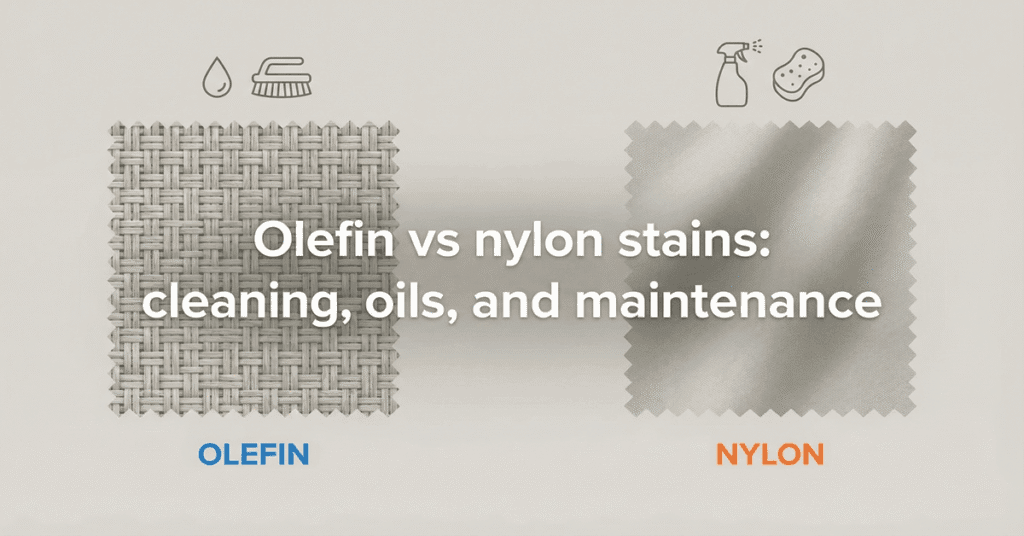
Olefin vs nylon stains: cleaning, oils, and maintenance
For stain behavior, olefin vs nylon carpet comes down to soil chemistry and dye method: olefin resists many water-based spills, yet it can hold onto oily grime; nylon resists wear well, yet some nylon styles need the right treatment plan for stains. Solution-dyed nylon (SDN) and solution-dyed olefin lock color in the fiber, which helps with cleanup and UV fade resistance. A simple routine matters as much as the fiber, and ANSI/IICRC S100 gives a safe baseline for professional-style carpet care.
Spill response in 5 steps (works for both fibers)
- Blot with white towels; press, do not rub.
- Rinse lightly with cool water; blot again.
- Use a carpet-approved spotter; match the product to the stain type.
- Rinse once more to reduce residue; blot until nearly dry.
- Speed-dry with airflow; vacuum after full drying to lift the pile.
Stain type → first treatment
| Stain type | Olefin first move | Nylon first move |
| Water-based (juice, soda) | Rinse + mild spotter | Rinse + mild spotter |
| Oil-based stains (grease) | Solvent-style spotter, careful rinse | Solvent-style spotter, careful rinse |
| Mud/soil | Dry, vacuum, then rinse | Dry, vacuum, then rinse |
| Pet accidents | Enzyme cleaner | Enzyme cleaner |
Does olefin carpet stain with oil and grease?
Yes, oily soils can cling to polypropylene and dull the color over time, even if it does not “stain” in the classic sense. Kitchen walkways and entry paths show this first, so mats, frequent vacuuming, and periodic hot-water extraction by a pro can keep olefin from looking gray.
Is nylon carpet stain-resistant without treatment?
Many nylon carpets handle spills well, yet performance varies by finish and dye method. SDN nylon often cleans up more predictably, and a tight construction helps since spills sit closer to the surface.
Cleaning mistakes that shorten carpet life
Residue is the silent problem: too much soap pulls in soil and makes traffic lanes look worse. Ask yourself one question after spot cleaning: Does the area feel sticky once dry?
Heat, friction, and tool mistakes (vacuums, furniture drag, steam misuse)
High heat and aggressive rubbing can distort fibers and set stains. Use a vacuum with strong airflow and a clean brush roll, lift furniture instead of dragging, and skip consumer steam tools that leave water behind in padding.
Maintenance schedules: busy homes vs low-traffic homes
Busy homes do best with vacuuming several times a week, mats at doors, and professional cleaning every 12–18 months. Low-traffic homes can stretch that interval, yet periodic deep cleaning still resets the fibers and improves appearance before wear locks in.
Best rooms for olefin vs nylon carpet
Olefin (polypropylene carpet) and nylon carpet perform best in different rooms once you factor in moisture, sun, traffic, and cleaning habits. Olefin carpet, often sold as solution-dyed olefin, handles UV fade resistance and damp conditions well. Nylon (nylon 6 or nylon 6,6), including solution-dyed nylon (SDN) options, holds up better against matting and crushing in busy paths and on stairs.
Room choice comes down to two questions: will the carpet get ground-in grit and repeated flexing, or will it face moisture and direct sun? Heavy traffic punishes low carpet density, low twist level, and tall pile height faster than most shoppers expect. If you hate footprints and vacuum marks, keep that in mind when you pick plush cut pile carpet for a high-use space. Here’s a quick guide to textured vs plush carpet for traffic and tracking.
Room/use-case matrix (fiber + construction)
| Stairs/hallways | Best fiber | Best pile style | Why it fits |
| Basement / below-grade | Olefin | Loop pile carpet | Moisture tolerance + colorfast fiber |
| Stairs / hallways | Nylon | Cut pile carpet (tight) | Resilience against crush + flex wear |
| Kids/pets living area | Nylon (SDN if available) | Cut pile carpet (dense) | Better appearance retention after cleanup |
| Room/use case | Olefin | Loop or low cut | Strong UV fade resistance |
| Rental refresh | Olefin (budget) or Nylon (mid) | Loop or short cut | Cost vs longevity trade-off |
Is olefin carpet good for basements and below-grade rooms?
Olefin carpet works well in basements that feel cool or damp, since polypropylene fiber resists moisture pickup and holds color well. Pair it with a low-profile loop pile carpet (many Berber carpet olefin styles) and choose carpet padding that does not trap water.
Is nylon carpet best for stairs and hallways?
Nylon is the safer pick for stairs and hallways since it rebounds better under repeated footfall. Look for higher carpet density and a tighter surface; those two factors reduce visible wear more than “softness” marketing.
Kids and pets: claw wear, cleanup, odors, and traction
For “olefin vs nylon carpet for pets,” nylon usually wins on looks over time, even after frequent spot cleaning. If Triexta is on your shortlist, compare nylon vs Triexta for pet cleanup and traffic. Olefin can show oily tracking faster in kitchens and entry zones; does olefin carpet attract oily dirt? It can, so a dense surface and strict vacuum routine matter.
Sunny rooms and indoor-outdoor spaces: fade and moisture priorities
Olefin’s solution-dyed color runs through the fiber, so bright rooms tend to stay truer longer. Keep pile height modest to reduce snagging and to keep grit from settling deep.
Rentals and budget remodels: what “good enough” looks like
A tight loop or short cut pile in olefin can be a practical reset for rentals with light-to-medium traffic. Pick low-VOC options with CRI Green Label Plus when indoor air quality matters.
Olefin vs nylon carpet cost: price, installation, value
Olefin vs nylon carpet cost comes down to fiber price, construction, and the “extras” that show up on the installer quote. Olefin (polypropylene) often lands lower upfront, yet nylon can cost less per year in busy homes since it resists matting longer. The best value shows up when you compare the installed price plus the expected replacement timing.
Here’s the fast way to read a quote: separate material cost from labor cost, then flag line items that change with stairs, furniture, and old-floor removal. Ask one question before you sign: Is this a dense product with real twist, or a light carpet that looks good only in the showroom?
Cost drivers that move your total
| Cost driver | What changes | Why it matters |
| Fiber + construction | loop vs cut pile, density, face weight | Durability and appearance retention |
| Stairs labor | per-step pricing | Stairs raise labor fast |
| Pad choice | thickness, firmness, moisture profile | Comfort and wear support |
| Removal + prep | tear-out, subfloor fixes | Prevents ripples and early wear |
| Warranty tier | stain/texture coverage | Limits matter more than the label |
Nylon vs olefin carpet: what changes the price most?
Construction drives cost more than shoppers expect. Higher face weight paired with solid carpet density costs more, yet it can reduce footprints and vacuum marks and slow texture loss.
Installed cost checklist: pad, stairs, removal, and waste factor
Use this quick check before comparing bids: stairs counted, pad line item listed, removal listed, and waste factor explained. If any part is missing, the “cheap” quote may rise later.
When nylon is cheaper long-term (and when it isn’t)
Nylon often wins in high-traffic zones where replacement comes from flattening, not stains. Olefin can win in basements and sunny rooms where moisture and UV fade resistance matter more than resilience. Next, use the shopping checklist in the next section to compare tags for twist level, pile height, and padding in a way sales talk cannot blur.
How to shop smarter than “nylon vs olefin”
A smart carpet buy starts with measurable specs, not fiber hype. Nylon carpet (nylon 6 or nylon 6,6) and olefin carpet (polypropylene carpet) can both fail fast if the construction is weak, the carpet padding is wrong, or the installer ignores CRI 104/105 basics. Treat fiber as the “engine,” then judge the “chassis” using carpet density, face weight, twist level, pile height, and whether the style will show footprints and vacuum marks or matting and crushing (and if you’re weighing natural fibers, see wool vs synthetic carpet pros and trade-offs).
Carpet specs that matter more than fiber
A label that says “nylon” or “solution-dyed olefin” tells you stain behavior and color, not how the carpet holds up on stairs. Build your shortlist by comparing a loop pile carpet (common for Berber carpet olefin) against a cut pile carpet (common in nylon) using density and twist, then connect those numbers to your traffic zones.
Density, face weight, twist, pile height (and how to compare tags)
Higher density and a healthy twist level reduce flattening, even when two samples share the same fiber. Short-to-moderate pile height usually shows less crushing in busy halls, and it can hide grit better than a loose, tall pile that “lays over” early. If you want a quick in-store filter, use this checklist and keep it in your notes:
- Ask for the density and face weight in writing (same style, same width)
- Check twist level on cut pile (low twist can look tired fast)
- Compare pile height on similar styles (shorter often wears steadier)
- Hold samples edge-to-edge and look for gaps at the base (loose build is a red flag)
- Rub a dark sample with your thumb (look for fast “shading” and tracking)
Quick spec cheat sheet (small table)
| Spec on tag | What it predicts | Red flag in stores |
| Carpet density | wear, matting, stability | “Plush feel” with no numbers |
| Twist level | fuzzing, texture hold | very soft cut pile with low twist |
| Pile height | tracking, crushing | tall pile in stairs/halls |
| Face weight | material amount | used as the only “quality” proof |
Best carpet padding for nylon vs olefin
Carpet padding/cushion changes how both fibers wear and feel. A premium nylon can still show dents if the pad is too soft, and olefin can ripple if the pad does not match the backing and traffic load. Start by dialing in 6lb vs 8lb carpet pad firmness for the room.
Moisture-prone rooms: pad choices that reduce risk
In basements, look for padding made for moisture control and pair it with solution-dyed olefin or solution-dyed nylon (SDN) when sunlight and spills are common. Ask the retailer for CRI Green Label Plus paperwork if indoor air quality matters in bedrooms or playrooms.
Warranty language to read before you buy
Warranties often separate “stain resistance” from “soil,” and complaints about olefin start with oil-based stains and oily soil. Look for cleaning requirements, exclusions for stairs, and the fine print on “texture retention,” since that is where matting and crushing claims live.
Sample shopping script: what to ask the retailer
“Can you show me two options with the same style and backing one nylon 6,6 and one polypropylene and print the density, face weight, twist level, and pile height?”
“If this is for stairs, which pad and install method do you recommend under CRI 104/105, and what voids the warranty?”
“One more question: how does this handle oily soil and tracking, and what cleaning method do you suggest under ANSI/IICRC S100?”

Frequently Asked Questions
Nylon vs olefin carpet: which is better for pets?
For most pet homes, nylon carpet wins on resilience and looks over time, so traffic lanes, matting, and crushing show less. Olefin (polypropylene carpet) resists moisture and many water-based spills, yet it can hold onto oil-based stains and body oils that make the surface look dull. Pick a tighter carpet density and the right carpet padding either way.
Is olefin carpet good for basements with moisture risk?
Yes, olefin carpet can fit basements since solution-dyed olefin handles moisture and UV better than many dyed fibers. The risk is appearance wear in walk paths, plus oily soil near storage or workshop zones. Pair it with a moisture-smart pad, keep a dehumidifier plan, and check for CRI Green Label Plus on the carpet and cushion.
Is olefin carpet good for stairs, or should I choose nylon?
Stairs punish fiber and construction, so nylon carpet is usually the safer bet for long-term shape and fewer footprints and vacuum marks. If you still want olefin for budget, look for tight loop pile carpet or low pile height, then compare face weight and density side by side. Ask: will this still look clean after 12 months of daily climbs?
Does olefin carpet attract oily dirt and look dingy faster?
Olefin has a reputation for holding oily soil, so entryways and kitchens can look gray faster even after vacuuming. That shows up most on light Berber carpet olefin in a loop pile. Strong mats at doors, frequent vacuuming, and quick spot work help, yet nylon often stays “brighter” longer in the same lane.
How long does nylon carpet last in high-traffic areas?
In busy halls and living rooms, nylon often lasts longer than olefin in real appearance retention, especially with good twist level, strong carpet density, and moderate pile height. Traffic life is not just fiber; grit control and pad choice matter a lot. Use a tighter cut pile or textured style for fewer visible crush marks.
Is nylon carpet worth the extra cost for resale value?
Often yes, if buyers will notice cleaner lines on stairs, fewer crush paths, and a softer hand. A mid-grade nylon with solid density can outperform a cheap nylon, so read the spec label, not the sales pitch. If indoor air quality is a selling point, look for CRI Green Label Plus listings on carpet and pad.
What are the biggest mistakes people make when choosing carpet fiber?
The biggest mistake is picking fiber first, then ignoring construction and pad. Compare nylon 6 vs nylon 6,6, check if it is solution-dyed nylon (SDN), and match fiber to the room’s soil type and sun exposure for UV fade resistance. For cleaning plans, align expectations with ANSI/IICRC S100 guidance. Head to the conclusion for a quick recap.
Conclusion
Fiber choice plus construction specs decide how carpet holds up under traffic, stains, sun, and moisture. Nylon (nylon 6 and nylon 6,6) tends to keep its shape better, so stairs and hallways show less matting and crushing. Olefin (polypropylene carpet), often solution-dyed, can shine in basements or sunny rooms when moisture and UV fade resistance matter most.
You can now shop with clearer signals: carpet density, face weight, twist level, pile height, and the right carpet padding. You can spot where oil-based stains and oily soil are the real risk, and where a loop pile carpet like Berber helps or hurts. If indoor air quality is on your list, CRI Green Label Plus is a clean way to compare options. Before you buy, test two samples in your home light and read the warranty language with a calm eye. Want a quick final check? Use the decision checklist to pick olefin vs nylon carpet with confidence.