Disclosure: Classy Floor is reader-supported. As an Amazon Associate, we earn from qualifying purchases. We may also earn commissions from other affiliate programs, at no additional cost to you. Learn more →
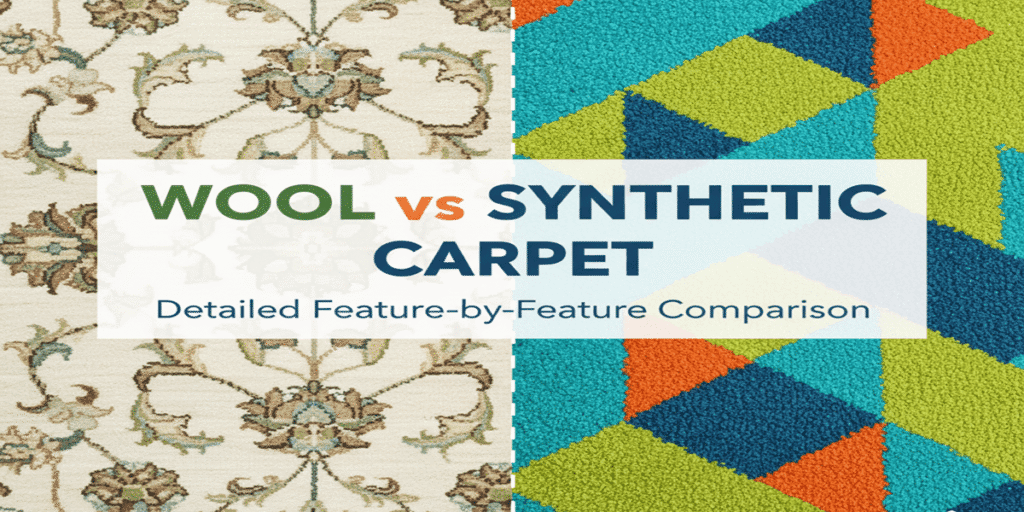
Choosing between wool vs synthetic carpet is not simply a choice between natural and man-made fibers.
Wool feels warm, resilient, and distinctly premium underfoot. Synthetic carpet usually costs less, handles spills more easily, and gives you more practical options for busy rooms. But “synthetic” covers several very different fibers, including nylon, triexta, polyester, and polypropylene.
The short answer is this: choose wool carpet when natural feel, comfort, appearance, and long-term character matter most. Choose synthetic carpet when stain resistance, easier maintenance, kids, pets, moisture, or a tighter budget matter more.
For many homes, using both in different rooms makes the most sense.
Wool vs Synthetic Carpet: Quick Answer
Wool is usually the better fit for bedrooms, formal living rooms, studies, and other comfort-focused spaces. Synthetic carpet, especially quality nylon or triexta, is usually more practical for family rooms, hallways, stairs, kids’ rooms, and homes with pets.
Wool has natural crimp and elasticity that give it a full, warm feel. It can retain an attractive appearance for years when the construction suits the room and the carpet receives proper care.
Synthetic carpet gives you a wider price range and generally easier stain management. Nylon stands out for resilience, while triexta combines softness with excellent stain resistance.
Here’s the thing: fiber alone does not determine whether a carpet is good. Density, pile construction, yarn twist, cushion, installation, and traffic can matter just as much.
Wool vs Synthetic Carpet at a Glance
| Factor | Wool | Nylon | Triexta | Polyester | Polypropylene |
| Fiber source | Natural protein fiber | Synthetic polyamide | Synthetic PTT | Synthetic PET | Synthetic olefin |
| Typical upfront cost | High | Medium to high | Medium | Low to medium | Low |
| Feel | Warm, springy, premium | Varies from firm to very soft | Very soft and springy | Soft | Moderate |
| Heavy traffic | Good with proper construction | Excellent | Very good | Fair to good | Fair |
| Stain resistance | Moderate | Very good, especially solution-dyed | Excellent | Very good for many spills | Excellent for many water-based stains |
| Cleaning | Requires more care | Relatively easy | Easy | Easy | Easy |
| Kids and pets | Good with careful maintenance | Excellent | Excellent | Good in moderate traffic | Situational |
| Moisture tolerance | Lower | Good | Good | Good | Excellent |
| UV performance | Depends on dye and exposure | Excellent when solution-dyed | Very good | Very good | Very good |
| Best overall use | Premium, quieter spaces | Heavy traffic | Busy family homes | Budget softness | Moisture and value |
The important question is not, “Which fiber wins?”
Ask instead, “Which fiber solves the problem in this room?”
That leads to a much better purchase.
How This Comparison Was Evaluated
This guide compares wool and synthetic carpet using the factors that affect real-world ownership: appearance retention, stain and soil behavior, cleaning, moisture, traffic, current U.S. pricing, comfort, construction, cushion, indoor emissions, and expected use.
The recommendations also distinguish between the main synthetic fibers rather than treating them as interchangeable. Third-party carpet-care, emissions, and lifecycle research are used where those details matter.
That matters because a dense nylon carpet on the right cushion can outperform a poorly specified wool carpet in a busy hallway, even though wool is the more expensive fiber.

What Is Synthetic Carpet?
Synthetic carpet is carpet made primarily from manufactured fibers rather than animal or plant fibers. The major types are nylon, triexta, polyester, and polypropylene.
When you are comparing carpet fibers, it helps to look beyond the fiber name. The Carpet and Rug Institute’s guidance on choosing carpet for different rooms and traffic levels also emphasizes construction and cushion as part of the decision.
Nylon is the established high-performance synthetic. It has strong resilience and works especially well where foot traffic is concentrated.
Triexta, or PTT, combines a soft feel with strong built-in stain resistance. It is particularly attractive for family rooms, kids, and pets.
Polyester, usually PET, delivers softness and color at a lower price. Recycled PET is also widely available.
Polypropylene, also called olefin, absorbs very little moisture and handles many water-based stains well. Its weakness is texture retention under concentrated traffic.
You will also encounter wool blends, often wool mixed with nylon. An 80/20 wool-nylon blend, for example, aims to preserve much of wool’s natural character while adding synthetic reinforcement.
If your decision extends beyond wool to plant-based fibers as well, the broader differences between natural and manufactured carpet materials deserve separate consideration.
Triexta vs Wool Carpet: Which Is Better?
The triexta vs wool carpet comparison deserves special attention because both can appeal to buyers looking for a soft, premium-feeling floor.
They achieve that feel differently.
Wool gets much of its spring and body from natural crimp. It feels warm and substantial rather than silky, and a well-constructed wool carpet can age gracefully in a suitable room.
Triexta tends to feel smoother. Its biggest practical advantage is stain resistance, which is inherent to the fiber rather than depending entirely on a surface treatment.
Imagine a busy family room where a child spills a bright drink while a dog comes in with damp paws. Triexta makes that scenario much less stressful. Put the same comparison in a quiet primary bedroom, where spills are unusual and tactile warmth matters more, and wool becomes far more compelling.
For kids, pets, and frequent spills, triexta usually wins.
For natural materials, warmth, and premium quiet-room comfort, wool usually wins.
Wool is not difficult to own, but cleaner selection matters. When you need to treat a stain or deep-clean the carpet, using a product that has been tested for compatibility with wool fibers is safer than assuming every general carpet cleaner will work.
If triexta is high on your shortlist, it is worth understanding where the fiber performs particularly well and where its trade-offs appear.
Wool vs Synthetic Carpet: 9 Differences That Matter
1. Durability and Appearance Retention
A carpet can remain physically intact and still look tired. That is why appearance retention is often more useful than a simple lifespan number.
Wool has excellent natural resilience. Nylon also performs exceptionally well under concentrated residential traffic, while triexta offers strong recovery for busy family use.
Polyester can look excellent when new but may show matting sooner in demanding traffic lanes. Polypropylene is generally better when moisture resistance and low price matter more than maximum texture retention.
Construction changes the equation. Density, yarn twist, pile height, backing, cushion, and traffic all affect how quickly a carpet changes appearance.
For stairs and hallways, it makes more sense to compare products designed for repeated heavy foot traffic than to choose by fiber name alone.
2. Stain Resistance and Soil Resistance
These are not the same thing.
A carpet may resist a spilled drink yet slowly become dull from body oils, cooking residue, or tracked-in grime.
Wool’s outer fiber structure can initially slow wetting, but once contamination enters the pile, appropriate cleaning matters.
Solution-dyed nylon performs very well against many household stains. Triexta is another standout. Polyester and polypropylene resist many water-based spills because they are hydrophobic, but oily soil can cling to hydrophobic fibers and become more noticeable over time.
So when you see “stain resistant” on a sample card, ask another question:
How does this carpet handle soil?
That answer may matter more in year five than it does on installation day.
3. Cleaning and Maintenance
Synthetic carpet generally wins for ease of maintenance.
Nylon, triexta, polyester, and polypropylene tolerate routine residential cleaning well when you follow manufacturer instructions. Wool is less forgiving of unsuitable cleaners or overly aggressive treatment.
That does not make wool impractical. It simply rewards better habits.
Vacuum consistently, deal with spills early, and use a wool-compatible product when required.
No matter which fiber you choose, drying after deep cleaning matters. Getting the floor dry again without trapping excess moisture helps protect the carpet, cushion, and materials underneath.
4. Wool Carpet vs Synthetic Cost in 2026
Wool usually costs considerably more upfront.
Current U.S. market estimates put wool carpet at roughly $8 to $25 per square foot for material, while many synthetic carpets fall around $2 to $10 per square foot. Within the synthetic category, nylon and triexta generally sit toward the higher end, while polyester and polypropylene tend to start lower. You can use these current wool and synthetic carpet price ranges as a benchmark before comparing local quotes.
Those figures are shopping benchmarks, not guaranteed project prices. Construction, brand, pattern, padding, room layout, labor, stairs, old-floor removal, and subfloor work can change the total substantially.
A simple example shows why the difference matters. If a 150-square-foot room uses wool priced at $12 per square foot instead of synthetic carpet at $5, the material difference alone is about $1,050 before installation and padding.
But cheaper upfront does not automatically mean cheaper over time.
A carpet that retains its appearance through a longer replacement cycle may produce better lifetime value. When budgeting for the entire project, it also helps to compare carpet costs with other common flooring options.
After you know the fiber and construction you want, you can compare available wool carpet styles without letting price alone make the decision.
5. Softness, Warmth, and Sound
Wool has a feel that synthetics can imitate but do not perfectly duplicate.
It tends to feel warm, springy, and substantial. Its natural structure also contributes to thermal and acoustic comfort.
Triexta can be exceptionally soft, sometimes softer to the fingertips than wool. Premium nylon can feel excellent too.
Here is a mildly surprising point: the softest carpet sample in the showroom is not necessarily the best carpet for the room.
A very soft product with loose construction can flatten sooner than a slightly firmer carpet with better density and twist. Showroom touch tests tell you how a carpet feels today, not how it will look after years of traffic.
For bedrooms and quiet living spaces, wool remains difficult to beat when the budget allows it. Triexta gives you a strong alternative when softness and easier maintenance need to coexist.
6. Kids and Pets
In an active household, synthetic carpet has a practical advantage.
Triexta and solution-dyed nylon are the strongest all-around options when you expect repeated spills, pet accidents, cleaning, and traffic.
Wool can absolutely work in a family home, but it asks more from the owner. A spill should not sit unnoticed for hours and then receive whatever strong cleaner happens to be nearby.
A practical compromise is wool in a primary bedroom, study, or formal sitting room and synthetic carpet in family rooms, play areas, hallways, or stairs.
7. Moisture, Basements, and Sunlight
Wool can absorb and release moisture from the surrounding air, but persistent dampness is different from normal indoor humidity.
A basement with recurring moisture, seepage risk, or poor drying is generally not the best place for wool.
Synthetic fibers absorb less moisture. Polypropylene is particularly hydrophobic, although backing, cushion, subfloor moisture, and ventilation still matter.
If a room already has a moisture history, check for signs that the carpet or flooring system may be staying damp before installing a replacement.
Strong sunlight is another consideration. Solution-dyed synthetic carpet generally offers excellent colorfastness, which makes it attractive for rooms with large sunny windows.
8. Fire Behavior and Insects
Wool behaves differently from thermoplastic synthetic fibers around high heat. It tends to char instead of melting like many synthetics.
Finished carpet performance still depends on the complete product, including backing and construction, so buying decisions should rely on the manufacturer’s tested specifications rather than fiber reputation alone.
Wool also has an ownership issue most synthetics largely avoid: moth or carpet beetle larvae can feed on protein fibers under suitable conditions.
Modern wool carpets may receive protective treatments, but it is still worth checking product specifications and warranty terms.
Loose fiber shedding is a different issue. A small amount can be normal early on with some cut-pile wool carpets. The distinction between normal shedding and a genuine problem is explained in more detail in this guide to why wool carpet may release loose fibers.
9. Indoor Air Quality and Sustainability
Do not reduce this comparison to “natural equals healthy” and “synthetic equals unhealthy.”
Carpet fiber is only one component of the installed flooring system. Cushion, backing, adhesives, installation conditions, ventilation, and cleaning products matter too.
If low indoor emissions are a priority, look for carpet, cushion, and adhesive products that meet independent low-VOC testing requirements rather than judging indoor air quality from the fiber name alone.
Wool has clear environmental advantages. The fiber comes from a renewable source and is biodegradable.
That still does not make wool the automatic environmental winner in every category.
Research comparing the life cycles of wool and nylon carpet has found different trade-offs in energy use and greenhouse gas emissions, which is why a useful sustainability comparison needs to consider production, use, recycling, and end-of-life impacts together.
Look at sourcing, recycled content, useful life, maintenance, and disposal or recycling options as a complete system.
Wool vs Specific Synthetic Fibers
Wool Compared With Nylon
Nylon is the synthetic benchmark when resilience and concentrated traffic matter.
Wool gives you natural warmth and premium character. Nylon generally gives you easier maintenance and greater flexibility in hard-working rooms, particularly when the fiber is solution-dyed.
This comparison has its own search intent, so the finer details belong in a deeper comparison of wool and nylon performance rather than being duplicated here.
Wool Compared With Polyester
Polyester costs less and can feel impressively soft. It also resists many common water-based stains.
Wool generally offers stronger natural resilience and a more distinctive premium feel.
Polyester makes the most sense in budget-conscious bedrooms and moderate-use spaces. Before choosing it purely for price, consider where polyester works well and where it tends to struggle.
Wool Compared With Polypropylene
Polypropylene, or olefin, absorbs very little moisture and is relatively inexpensive. That makes it useful for some indoor-outdoor, damp, or value-focused applications.
Wool feels more luxurious and generally offers better recovery in suitable residential construction.
These two fibers rarely compete for exactly the same job. Wool fits comfort-focused interiors. Polypropylene makes more sense when moisture resistance and price dominate the decision.

Which Carpet Is Best for Each Room?
| Room or Situation | Better Starting Point | Main Reason |
| Primary bedroom | Wool or premium triexta | Comfort and softness |
| Formal living room | Wool | Natural feel and appearance |
| Busy family room | Triexta or solution-dyed nylon | Stains and traffic |
| Kids’ room | Triexta, nylon, or quality polyester | Easier cleanup |
| Stairs | Dense nylon, triexta, or suitable wool blend | Concentrated wear |
| Hallway | Nylon or triexta | Appearance retention |
| Pet household | Triexta or solution-dyed nylon | Cleaning and stains |
| Basement | Moisture-appropriate synthetic | Lower moisture sensitivity |
| Rental | Nylon, polyester, or polypropylene | Cost and replacement economics |
There is no rule that every room needs the same carpet fiber.
In fact, mixing fibers according to room use is often the more rational approach.
How to Choose a Good Carpet Beyond Fiber Type
This is where many buying decisions go wrong.
Do not stop at a label that says “100% wool,” “nylon,” or “triexta.”
Check density
A denser pile generally provides better support under traffic because the yarns are packed more closely together.
Look at pile height
A taller pile can feel luxurious, but very soft, loose construction may show traffic sooner. Shorter, firmer constructions often make more sense where people repeatedly walk the same path.
Consider yarn twist
For many cut-pile carpets, tighter twist helps the yarn maintain its shape and resist untwisting or blooming.
Use face weight carefully
Face weight tells you how many ounces of pile fiber are used per square yard.
More is not automatically better.
A 60-ounce carpet is not necessarily superior to a 45-ounce carpet if fiber type, density, pile height, twist, and construction differ. Face weight is most useful when comparing reasonably similar carpets, not as a universal quality score.
Match the cushion to the carpet
Cushion affects support, comfort, appearance, and sometimes warranty compliance. Industry guidance on matching carpet with the correct cushion also warns that an unsuitable cushion can contribute to wrinkling, buckling, seam problems, and premature structural wear.
If pad specifications feel confusing, this comparison of different residential carpet pad densities explains why thicker or heavier is not automatically the right answer.
Read the warranty details
Look beyond the headline number.
Check:
- texture or appearance-retention coverage
- stain exclusions
- pet-related conditions
- stair exclusions
- required cleaning intervals
- cushion requirements
- installation requirements
A small showroom reality is easy to miss: the carpet that feels most luxurious on a sample rack may not be the carpet that looks best after five years.
Choose the whole flooring system, not just the fiber name.
Final Verdict: Wool or Synthetic Carpet?
For wool vs synthetic carpet, there is no universal winner.
Choose wool when you want natural warmth, premium feel, resilience, and a carpet for a room where careful maintenance is realistic.
Choose synthetic carpet when you need easier stain management, a lower initial cost, better practicality around kids or pets, or more flexibility in busy and moisture-prone spaces.
Among synthetic fibers, nylon is the established traffic performer, triexta is especially compelling for busy families, polyester provides affordable softness, and polypropylene works best when moisture resistance and value matter more than maximum texture retention.
Think about it this way: you are not simply choosing a fiber. You are choosing how you want a room to behave for the next several years.
Start with traffic, spills, cleaning habits, moisture, and budget. Then compare fiber, construction, cushion, and warranty together. Once you know what specifications actually fit the room, you can compare synthetic carpet options for your shortlist without letting a low price or a soft showroom sample make the decision for you.

Frequently Asked Questions (FAQ)
Is wool carpet better than synthetic?
Wool carpet is better when natural materials, warmth, resilient feel, and premium appearance are your priorities. Synthetic carpet is usually better when you need easier cleaning, stronger stain resistance, lower upfront cost, or practical performance around kids and pets.
Wool vs synthetic carpet: which lasts longer?
Either can last a long time when the carpet has good construction and suits the room. Premium wool offers excellent natural resilience, while quality nylon and triexta can maintain their appearance very well under heavier traffic. Density, pile height, twist, cushion, installation, maintenance, and traffic can matter as much as the fiber name.
Triexta vs wool carpet: which is better for families?
Triexta is usually the more practical choice for a busy family because it combines softness, strong stain resistance, and relatively easy cleaning. Wool offers a warmer natural feel but normally costs more and requires more careful spill treatment.
Is synthetic carpet cheaper than wool?
Usually, yes. Current 2026 U.S. market estimates put many wool carpets around $8 to $25 per square foot for materials, compared with roughly $2 to $10 for many synthetic carpets. Premium constructions can fall outside those ranges.
Which synthetic carpet feels most like wool?
There is no perfect substitute for wool’s natural crimp and warmth, but premium triexta and soft nylon can come close in comfort. Construction is critical, so a dense, well-made synthetic can feel more substantial than a poorly constructed wool carpet.
Is wool carpet more eco-friendly than synthetic?
Wool is renewable and biodegradable, which are meaningful advantages. However, lifecycle impact also depends on farming, manufacturing, recycled content, transportation, cleaning, useful life, and disposal or recycling. Neither fiber category wins every environmental measure.
What should I check besides carpet fiber?
Check density, pile height, yarn twist, face weight, backing, cushion requirements, solution-dyed construction where relevant, stain coverage, texture-retention warranty, and whether the product is rated for the traffic in the room. Those specifications often explain performance differences that the fiber label alone cannot.